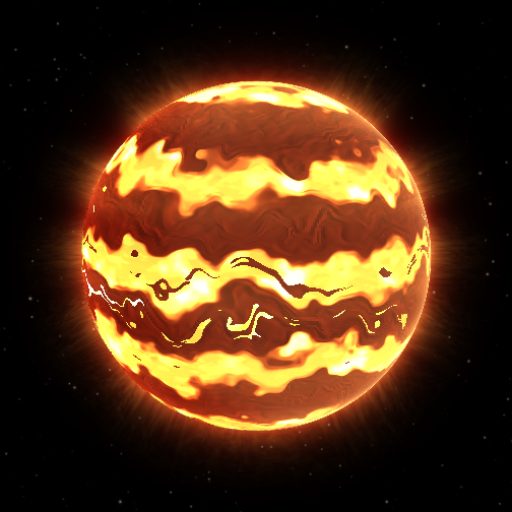
2MASS J1315-2649 b
Also written 2MASS J1315-2649b, 2MASS J1315 2649b, 2MASS J1315 2649 b
- Mass
- 8900.00 × Earth
- Radius
- 10.20 × Earth
- Gravity
- 85.54 g
- Surface (est.)
- 1,933 K
- Year
- 52.6 years
- From Earth
- 62 ly
- Mass
- 8900.00 × Earth
- Radius
- 10.20 × Earth
- Gravity
- 85.54 g
- Surface (est.)
- 1,933 K
- Year
- 52.6 years
- From Earth
- 62 ly
2MASS J1315-2649 system
- Type
- M-type (Red Dwarf)
- Spectral type
- L5Ve
- Temperature
- 1,770 K
- Radius
- 0.084 ☉
- Mass
- 0.074 ☉
- Planets
- 1
- Luminosity
- 6.24e-5 ☉
Published by the Extrasolar Planets Encyclopaedia. This world’s temperature and habitability score are computed from its star’s published radius and temperature.
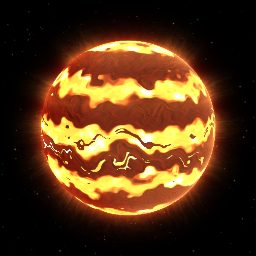 2MASS J1315-2649 b6.60 AUYou are here8,900 M⊕
Star and planets drawn to scale: 2MASS J1315-2649 b is 1.1 times as wide as its star. Orbits spaced as in the star system view.
Estimated: this planet doesn't transit its star, so its size is inferred, not measured
2MASS J1315-2649 b, from the Extrasolar Planets Encyclopaedia (found 2011). Measured: 8900 Earth masses, 6.6 AU, a 1770 K M-type star. Composition inferred from a mass of 8900 Earths, which is giant territory whatever its 8.39x density suggests, with an assumed 24-hour day — rotation cannot be measured for exoplanets. Note: TerraForge comes out at 1933 K against the archive's 670 K, because that figure is the planet's own heat, not the star's. It receives almost no sunlight out at this distance and is still glowing from its formation — TerraForge only warms worlds with starlight, so it has no way to model a planet heated from within.
Surface. No surface: a deuterium-burning sphere the size of Jupiter and dozens of times its mass, glowing dull red from its own heat

Hydrogen and helium with iron and silicate cloud decks - hot enough to rain molten metal
Hydrogen-rich atmosphere typical of gas giants