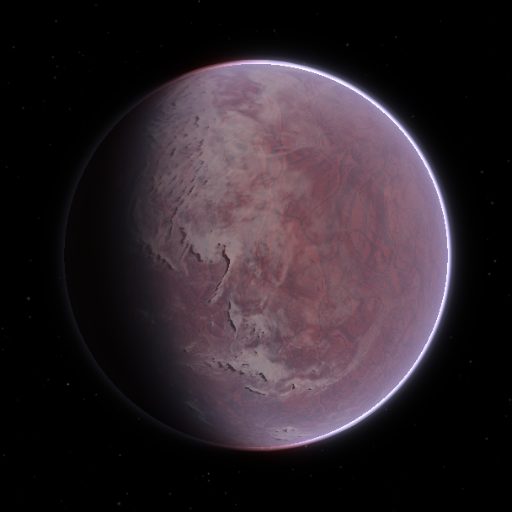
Barnard c
Also written Barnardc
- Mass
- 0.34 × Earth
- Radius (est.)
- 0.74 × Earth
- Gravity (est.)
- 0.61 g
- Surface (est.)
- 413 K
- Year
- 4.1 days
- From Earth
- 6 ly
- Mass
- 0.34 × Earth
- Radius (est.)
- 0.74 × Earth
- Gravity (est.)
- 0.61 g
- Surface (est.)
- 413 K
- Year
- 4.1 days
- From Earth
- 6 ly
Barnard's star system
- Type
- M-type (Red Dwarf)
- Spectral type
- M3.5-4 V
- Temperature
- 3,195 K
- Radius
- 0.185 ☉
- Mass
- 0.162 ☉
- Planets
- 4
- Luminosity
- 3.55e-3 ☉
Published by the NASA Exoplanet Archive. This world’s temperature and habitability score are computed from this star’s measured luminosity, not from a stand-in for its class.
 Barnard c0.027 AUYou are here0.3 M⊕
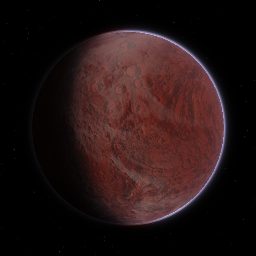
Star and planets drawn to scale: the star is 27 times as wide as Barnard c, so only its edge is in view. Orbits spaced as in the star system view.
Estimated: this planet doesn't transit its star, so its size is inferred, not measured
Barnard c is the heaviest of the four small planets around Barnard's Star, the closest single star to the Sun at about six light-years. Its minimum mass is about a third of Earth's, 0.335 Earth masses, yet it moves its star by less than half a metre per second. It was found together with its siblings: its signal first appeared in 2024 alongside Barnard b, and it was confirmed in 2025 along with planets d and e.
Surface. Rocky surface with impact craters, possible volcanic features
Thin CO₂ and nitrogen atmosphere
Nitrogen atmosphere provides protection but not breathable (its active star has stripped much of its air)Physical Properties
Time Dilation
Clocks run 5.1 seconds per year slower than deep space — about 7 minutes over a lifetimeElemental Composition
How TerraForge built this world
Barnard c, from the NASA Exoplanet Archive (found 2025). Measured: 0.335 Earth masses, 0.0274 AU, a 3195 K M-type star. Composition inferred from an estimated bulk density of 0.82x Earth's, modeled rather than measured since this isn't a transiting planet — the radius is the archive's estimate, so it can't settle how much water there is; read as rock and iron, with a day locked to its 4.1-day year, as it is predicted to be tidally locked: at this distance its star would have stopped its spin within a million years.