Create your free account

Enter your email and we'll send a 6-digit code — no password needed.
or use an email code
We only keep your email and the username you choose. We never share or sell your email, and we don't send marketing — we use it only to email you a sign-in code. Read our privacy policy.
Entering orbit…
Habitability
19/ 100
Uninhabitable
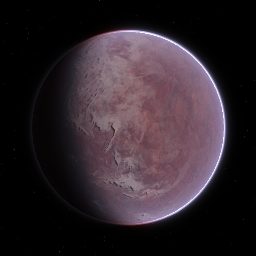
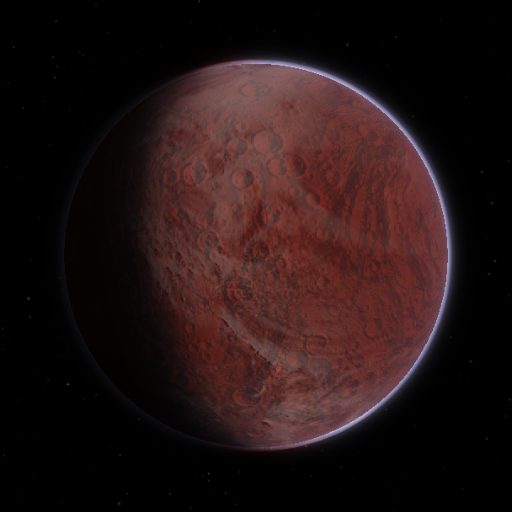
Barnard e rendered in TerraForge from its measured mass, orbit and star

Barnard e

Also written Barnarde

Rocky Terrestrial6 light years awayFound 2025
Mass
0.19 × Earth
Radius (est.)
0.64 × Earth
Gravity (est.)
0.48 g
Surface (est.)
350 K
Year
6.7 days
From Earth
6 ly
Mass
0.19 × Earth
Radius (est.)
0.64 × Earth
Gravity (est.)
0.48 g
Surface (est.)
350 K
Year
6.7 days
From Earth
6 ly

Barnard's star system

Type
M-type (Red Dwarf)
Spectral type
M3.5-4 V
Temperature
3,195 K
Radius
0.185 ☉
Mass
0.162 ☉
Planets
4
Luminosity
3.55e-3 ☉

Published by the NASA Exoplanet Archive. This world’s temperature and habitability score are computed from this star’s measured luminosity, not from a stand-in for its class.
Habitable zone

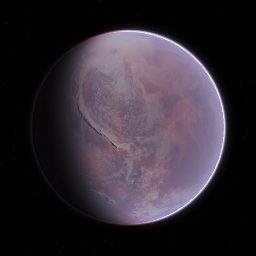
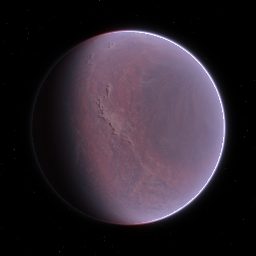
Star and planets drawn to scale: the star is 32 times as wide as Barnard e, so only its edge is in view. Orbits spaced as in the star system view.

Estimated: this planet doesn't transit its star, so its size is inferred, not measured

Barnard e is among the lightest planets ever found by the radial velocity method, which detects a planet from the small back-and-forth motion its gravity gives its star. Its minimum mass is about a fifth of Earth's. It is the outermost of four small planets now known around Barnard's Star, the closest single star to the Sun at about six light-years.

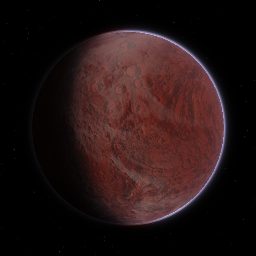
Surface. Rocky surface with impact craters, possible volcanic features

✓ Conditions could support life. This planet’s modelled conditions could support biological processes: stable temperatures, liquid water and the chemistry life as we know it needs. That makes life possible, not present.
Rocky Terrestrial
Life possibleNone Activity
Barnard e is dominated by silicate (25.0%) and iron (12.5%) content, forming a rocky terrestrial body.
Rocky terrestrial planets are primarily composed of silicate rocks and metals. They're the most common type of small planet in the universe.
Classification Criteria:
✓ Silicon: 25.0% + Iron: 12.5% + Magnesium: 3.8%✓ Mass: 0.2x Earth (terrestrial range)

Reading Barnard e’s atmosphere

Dominant elements: O, Si, Fe, N, C, HThis is what a telescope would measure while Barnard e crosses in front of its star: starlight passes through the atmosphere and spreads into a rainbow band. Each dark line marks a wavelength the atmosphere absorbed.Every element absorbs its own signature wavelengths — hydrogen always darkens the same two spots, calcium another pair, and so on. Astronomers match the lines in a real spectrum against a library of these signatures to say what an atmosphere is made of, light-years away, without ever visiting. A deeper line generally means more of that element is present.Barnard e sits about 6 light-years away, found by the radial velocity method. Most catalogued distances trace back to parallax: as Earth orbits the Sun, a nearby star appears to shift very slightly against the distant background stars, and the size of that shift gives its distance directly.
Habitability ScoreUninhabitable
19
Contributing Factors
temperature33
Hot - near boiling, only heat-loving microbes would thrive
atmosphere37

Thin CO₂ and nitrogen atmosphere

Nitrogen atmosphere provides protection but not breathable (its active star has stripped much of its air)
water22
Limited water content (low gravity lets water escape to space)
magnetic Field30
No magnetic field - vulnerable to solar radiation
geology30
Geologically dead - no nutrient recycling
Organic Chemistry80
Core organic elements (CHNO) present
rotation54
Very slow rotation - days and nights each last several Earth days, bringing extreme temperature swings

Physical Properties

Mass
0.19x Earth (1.15e+24 kg)
Radius
0.64x Earth (4,058 km)
Estimated by NASA, not measured
This planet: 0.64× Earth radiusEarth: 1× (baseline)
Surface Gravity
0.48x Earth (4.7 m/s²)
Worked out from an estimated size, not measured
Surface Temperature
350 K (77 °C / 170 °F)
Rotation Period
161.8 hours/day (slower than Earth)
This planet: 162 h/dayEarth: 24 h/day

Elemental Composition

How TerraForge built this world

Barnard e, from the NASA Exoplanet Archive (found 2025). Measured: 0.193 Earth masses, 0.0381 AU, a 3195 K M-type star. Composition inferred from an estimated bulk density of 0.75x Earth's, modeled rather than measured since this isn't a transiting planet — the radius is the archive's estimate, so it can't settle how much water there is; read as rock and iron, with a day locked to its 6.7-day year, as it is predicted to be tidally locked: at this distance its star would have stopped its spin within a million years.

New: Fly Over Your World

The surface view used to be a place to stand. Now it's a place to go. Open any rocky world's surface and fly: the arrow keys take you across the ground on a computer, and on a phone or tablet you go full screen and tap Fly. Skim the dunes, climb over a ridge to see what's behind it, drop into a valley. It all comes from the same numbers that shape the globe, so no two worlds fly the same, and the real exoplanets are in there too.

Create your free account

Enter your email and we'll send a 6-digit code — no password needed.
or use an email code
We only keep your email and the username you choose. We never share or sell your email, and we don't send marketing — we use it only to email you a sign-in code. Read our privacy policy.

One quick check

You must be 13 or older to create an account. What year were you born?
2026
2025
2024
2023
2022
2021
2020
2019
2018
2017
2016
2015
2014
2013
2012
2011
2010
2009
2008
2007
2006
2005
2004
2003
2002
2001
2000
1999
1998
1997
1996
1995
1994
1993
1992
1991
1990
1989
1988
1987
1986
1985
1984
1983
1982
1981
1980
1979
1978
1977
1976
1975
1974
1973
1972
1971
1970
1969
1968
1967
1966
1965
1964
1963
1962
1961
1960
1959
1958
1957
1956
1955
1954
1953
1952
1951
1950
1949
1948
1947
1946
1945
1944
1943
1942
1941
1940

Sign-in

Send feedback

We're still building out the best experience we can — and we'd love your input. Tell us about features you enjoy, ideas you'd like to see, or pain points where something feels off, and we'll know where to look next.

Type
Idea
Bug
Pain point
Other