Create your free account

Enter your email and we'll send a 6-digit code — no password needed.
or use an email code
We only keep your email and the username you choose. We never share or sell your email, and we don't send marketing — we use it only to email you a sign-in code. Read our privacy policy.
Entering orbit…
Habitability
0/ 100
Uninhabitable
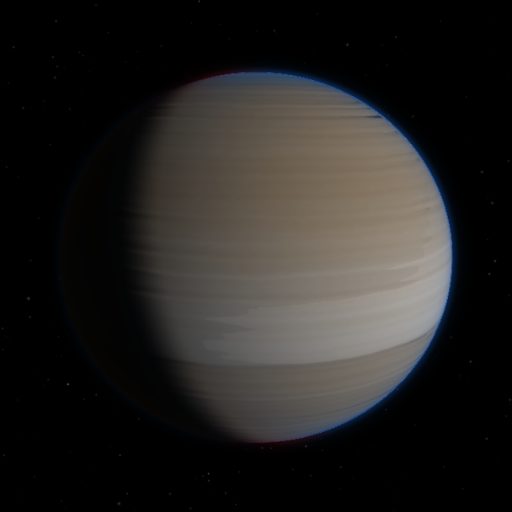
eps Ind A b rendered in TerraForge from its measured mass, orbit and star

eps Ind A b

Also written eps Ind Ab

Gas Giant12 light years awayFound 2019
Mass
2070.00 × Earth
Radius (est.)
12.70 × Earth
Gravity (est.)
12.83 g
Surface (est.)
49 K
Year
69.8 years
From Earth
11.9 ly
Mass
2070.00 × Earth
Radius (est.)
12.70 × Earth
Gravity (est.)
12.83 g
Surface (est.)
49 K
Year
69.8 years
From Earth
11.9 ly

eps Ind A system

Type
K-type (Orange)
Spectral type
K5 V
Temperature
4,700 K
Radius
0.713 ☉
Mass
0.8 ☉
Planets
1
Luminosity
0.239 ☉

Published by the NASA Exoplanet Archive. This world’s temperature and habitability score are computed from this star’s measured luminosity, not from a stand-in for its class.
Habitable zone

Star and planets drawn to scale: the star is 6.1 times as wide as eps Ind A b, so only its edge is in view. Orbits spaced as in the star system view.

Estimated: this planet doesn't transit its star, so its size is inferred, not measured

Epsilon Indi A b is a giant planet that has been photographed, not just inferred. In 2024 the James Webb Space Telescope captured an image of it next to its star, Epsilon Indi A, about 12 light-years away. It is one of the coldest planets ever imaged, at about 275 kelvin, close to the freezing point of water, and its star is about the age of the Sun. Almost every other directly imaged planet is a young, hot one that still glows from its formation, so a cold, old giant like this is rare.

Surface. No solid surface - thick gaseous envelope with possible rocky core deep within
Gas Giant
Magnetic FieldExtreme Activity
eps Ind A b has 86.0% hydrogen and helium, combined with a mass of 2070.0x Earth, which exceeds the gas giant threshold.
Gas giants form when massive cores capture enormous atmospheres of light gases. They typically form beyond the 'frost line' where volatiles can condense.
Classification Criteria:
✓ Hydrogen + Helium: 86.0% (>60% required)✓ Mass: 2070.0x Earth (>10x required)

Reading eps Ind A b’s atmosphere

Dominant elements: H, He, O, C, NThis is what a telescope would measure while eps Ind A b crosses in front of its star: starlight passes through the atmosphere and spreads into a rainbow band. Each dark line marks a wavelength the atmosphere absorbed.Every element absorbs its own signature wavelengths — hydrogen always darkens the same two spots, calcium another pair, and so on. Astronomers match the lines in a real spectrum against a library of these signatures to say what an atmosphere is made of, light-years away, without ever visiting. A deeper line generally means more of that element is present.eps Ind A b sits about 12 light-years away, found by the radial velocity method. Most catalogued distances trace back to parallax: as Earth orbits the Sun, a nearby star appears to shift very slightly against the distant background stars, and the size of that shift gives its distance directly.
Habitability ScoreUninhabitable
0
Contributing Factors
temperature0
Near absolute zero - all molecular activity ceases, impossible for life
atmosphere30

Hydrogen and helium dominated with trace methane and ammonia

Hydrogen-rich atmosphere typical of gas giants
water15
No solid surface — any water is locked in a supercritical mantle and hot ice, not oceans
magnetic Field100
Magnetic field provides radiation protection
geology40
Extreme volcanic activity may be hazardous
Organic Chemistry80
Core organic elements (CHNO) present
rotation43
Fast rotation - strong global wind patterns and weather systems, but manageable

Physical Properties

Mass
2070.00x Earth (1.24e+28 kg)
Radius
12.70x Earth (80,912 km)
Estimated by NASA, not measured
This planet: 12.70× Earth radiusEarth: 1× (baseline)
Surface Gravity
12.83x Earth (125.9 m/s²)
Worked out from an estimated size, not measured
Surface Temperature
49 K (-224 °C / -371 °F)
Rotation Period
10.0 hours/day (faster than Earth)
This planet: 10 h/dayEarth: 24 h/day

Elemental Composition

How TerraForge built this world

eps Ind A b, from the NASA Exoplanet Archive (found 2019). Measured: 2070 Earth masses, 15.8 AU, a 4700 K K-type star. Composition inferred from a mass of 2070 Earths, which is giant territory whatever its 1.01x density suggests, with an assumed 10-hour day, typical of giant planets (Jupiter 9.9 h) — rotation cannot be measured for exoplanets. Note: TerraForge comes out at 49 K against the archive's 275 K, because that figure is the planet's own heat, not the star's. It receives almost no sunlight out at this distance and is still glowing from its formation — TerraForge only warms worlds with starlight, so it has no way to model a planet heated from within.

New: Fly Over Your World

The surface view used to be a place to stand. Now it's a place to go. Open any rocky world's surface and fly: the arrow keys take you across the ground on a computer, and on a phone or tablet you go full screen and tap Fly. Skim the dunes, climb over a ridge to see what's behind it, drop into a valley. It all comes from the same numbers that shape the globe, so no two worlds fly the same, and the real exoplanets are in there too.

Create your free account

Enter your email and we'll send a 6-digit code — no password needed.
or use an email code
We only keep your email and the username you choose. We never share or sell your email, and we don't send marketing — we use it only to email you a sign-in code. Read our privacy policy.

One quick check

You must be 13 or older to create an account. What year were you born?
2026
2025
2024
2023
2022
2021
2020
2019
2018
2017
2016
2015
2014
2013
2012
2011
2010
2009
2008
2007
2006
2005
2004
2003
2002
2001
2000
1999
1998
1997
1996
1995
1994
1993
1992
1991
1990
1989
1988
1987
1986
1985
1984
1983
1982
1981
1980
1979
1978
1977
1976
1975
1974
1973
1972
1971
1970
1969
1968
1967
1966
1965
1964
1963
1962
1961
1960
1959
1958
1957
1956
1955
1954
1953
1952
1951
1950
1949
1948
1947
1946
1945
1944
1943
1942
1941
1940

Sign-in

Send feedback

We're still building out the best experience we can — and we'd love your input. Tell us about features you enjoy, ideas you'd like to see, or pain points where something feels off, and we'll know where to look next.

Type
Idea
Bug
Pain point
Other