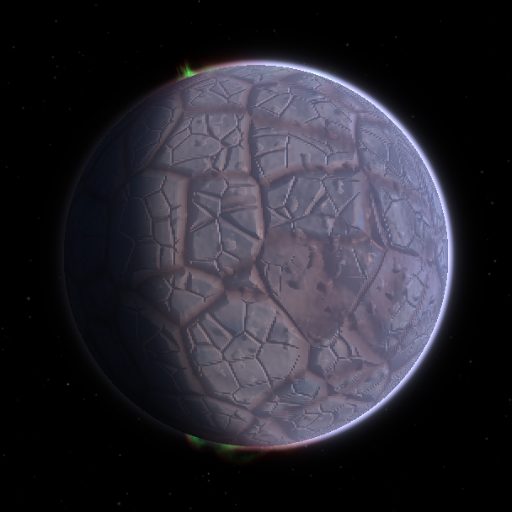
GJ 514 b
Also written GJ 514b
- Mass
- 5.20 × Earth
- Radius
- 2.13 × Earth
- Gravity
- 1.15 g
- Surface (est.)
- 215 K
- Year
- 140 days
- From Earth
- 24.9 ly
- Mass
- 5.20 × Earth
- Radius
- 2.13 × Earth
- Gravity
- 1.15 g
- Surface (est.)
- 215 K
- Year
- 140 days
- From Earth
- 24.9 ly
GJ 514 system
- Type
- K-type (Orange)
- Spectral type
- M0.5-1.0 V
- Temperature
- 3,728 K
- Radius
- 0.5 ☉
- Mass
- 0.51 ☉
- Planets
- 1
- Luminosity
- 0.0430 ☉
Published by the NASA Exoplanet Archive. This world’s temperature and habitability score are computed from this star’s measured luminosity, not from a stand-in for its class.
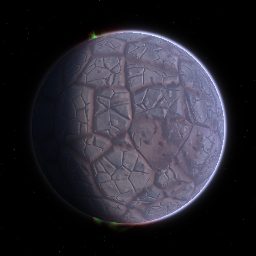 GJ 514 b0.42 AUYou are here5.2 M⊕
Star and planets drawn to scale: the star is 26 times as wide as GJ 514 b, so only its edge is in view. Orbits spaced as in the star system view.
Estimated: this planet doesn't transit its star, so its size is inferred, not measured
GJ 514 b, from the NASA Exoplanet Archive (found 2022). Measured: 5.2 Earth masses, 0.422 AU, a 3728 K K-type star. Composition inferred from an estimated bulk density of 0.54x Earth's, modeled rather than measured since this isn't a transiting planet — an envelope can't be inferred from estimated figures, so it is read as rock and iron, with an assumed 24-hour day, though it may be tidally locked: its star would stop its spin within 1.2 billion years, close to the star's age of 800 million years, so the day is assumed.
Surface. Frozen surface covered in water ice, possible subsurface ocean if tidal heating present


Thin nitrogen and methane atmosphere
Nitrogen atmosphere provides protection but not breathable