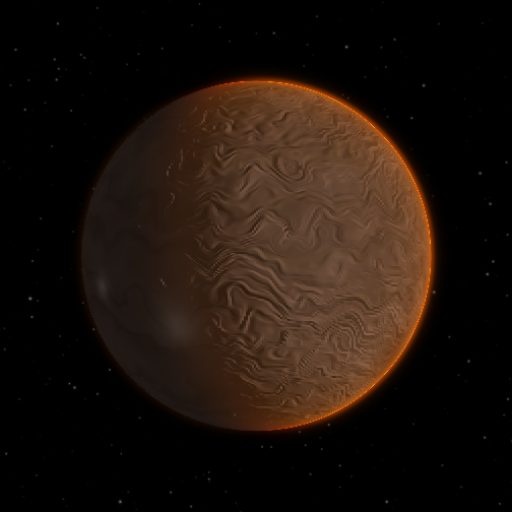
GJ 649 c
Also written GJ 649c
Sub-NeptuneUninhabitable34 light years awayFound 2013
exoplanet.euListed by the Extrasolar Planets Encyclopaedia; not yet in NASA's confirmed catalogue.View on exoplanet.eu
Estimated: this planet doesn't transit its star, so its size is inferred, not measured
GJ 649 c, from the Extrasolar Planets Encyclopaedia (found 2013). Measured: 9.53 Earth masses, 0.043 AU, a 3700 K K-type star. Composition inferred from a estimated bulk density of 0.34x Earth's, modeled rather than measured since this isn't a transiting planet, too low for bare rock at this size, suggesting a rocky core under roughly a 9% hydrogen/helium envelope by mass, with a day locked to its 4.5-day year, as anything orbiting this close would be.
GJ 649
- Type
- K-type (Orange)
- Spectral type
- M1.5
- Temperature
- 3,700 K
- Mass
- 0.54 ☉
- Known planets
- 2, including this one
Published by the Extrasolar Planets Encyclopaedia. This star’s luminosity has not been published, so this world’s temperature and habitability score fall back to a typical K-type star.
Gas Dwarf
Life unlikely — too hot for liquid waterLow Activity
Why is this a Gas Dwarf?
GJ 649 c has an unusual composition that doesn't fit standard classifications, or lacks the elements needed for complex geological processes.Barren worlds can form from uncommon element combinations or may be remnants of larger bodies that lost their atmospheres and volatile materials.
Classification Criteria:
Composition doesn't match standard planet typesMass: 9.5x EarthTemperature: 1081K

Habitability ScoreUninhabitable
Contributing Factors
temperature0
Inferno world - temperatures exceed all possibility of life
atmosphere30
Hydrogen-rich atmosphere typical of gas giants
water15
No solid surface — any water is locked in a supercritical mantle and hot ice, not oceans
magnetic Field30
No magnetic field - vulnerable to solar radiation
geology60
Some geological activity provides slow nutrient cycling
Organic Chemistry80
Core organic elements (CHNO) present
rotation30
Very slow rotation - extreme temperature swings between eternal day and night sides
Physical Properties
Mass
9.53x Earth (5.69e+25 kg)Radius
2.12x Earth (13,507 km)Surface Gravity
2.12x Earth (20.8 m/s²)Surface Temperature
1,081 K (808 °C / 1,487 °F)Rotation Period
107.5 hours/day (slower than Earth)Orbital Environment
Star Type
K-type (Orange)Distance from Star
0.04 AU (6.43 million km)Orbital Period
4 daysTime Dilation
Clocks run 7.6 seconds per year slower than deep space — about 10 minutes over a lifetimeAtmosphere
Deep hydrogen-helium envelope with photochemical haze
Elemental Composition
O - Oxygen
31.3%
Si - Silicon
25.0%
Fe - Iron
12.5%
Surface Characteristics
No solid surface - a hydrogen-helium envelope wrapped around a rocky core (a sub-Neptune)Love TerraForge? Please help support us.Keeps it ad-free, and funds new features and hosting.