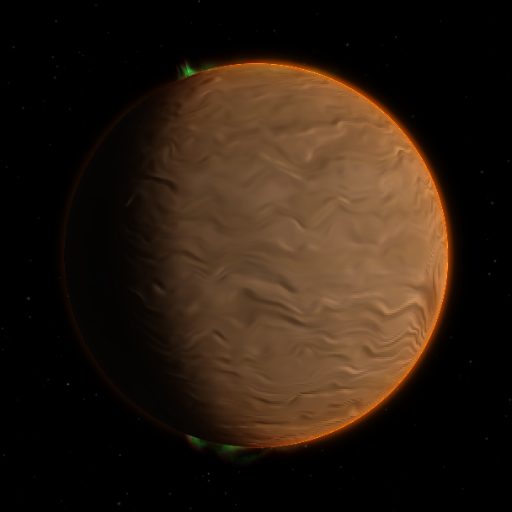
GJ 674 b
Also written GJ 674b
- Mass
- 11.10 × Earth
- Radius (est.)
- 3.33 × Earth
- Gravity (est.)
- 1.00 g
- Surface (est.)
- 508 K
- Year
- 4.7 days
- From Earth
- 14.8 ly
- Mass
- 11.10 × Earth
- Radius (est.)
- 3.33 × Earth
- Gravity (est.)
- 1.00 g
- Surface (est.)
- 508 K
- Year
- 4.7 days
- From Earth
- 14.8 ly
GJ 674 system
- Type
- M-type (Red Dwarf)
- Spectral type
- M2.5
- Temperature
- 3,600 K
- Radius
- 0.365 ☉
- Mass
- 0.35 ☉
- Planets
- 1
- Luminosity
- 0.0160 ☉
Published by the NASA Exoplanet Archive. This world’s temperature and habitability score are computed from this star’s measured luminosity, not from a stand-in for its class.
 GJ 674 b0.039 AUYou are here11 M⊕
Star and planets drawn to scale: the star is 12 times as wide as GJ 674 b, so only its edge is in view. Orbits spaced as in the star system view.
Estimated: this planet doesn't transit its star, so its size is inferred, not measured
GJ 674 b, from the NASA Exoplanet Archive (found 2007). Measured: 11.1 Earth masses, 0.039 AU, a 3600 K M-type star. Composition inferred from a estimated bulk density of 0.30x Earth's, modeled rather than measured since this isn't a transiting planet, too low for bare rock at this size, suggesting a rocky core under roughly a 11% hydrogen/helium envelope by mass, with a day locked to its 4.7-day year, as it is predicted to be tidally locked: at this distance its star would have stopped its spin within a million years.
Surface. No solid surface - a hydrogen-helium envelope wrapped around a rocky core (a sub-Neptune)

Deep hydrogen-helium envelope with photochemical haze
Hydrogen-rich atmosphere typical of gas giants