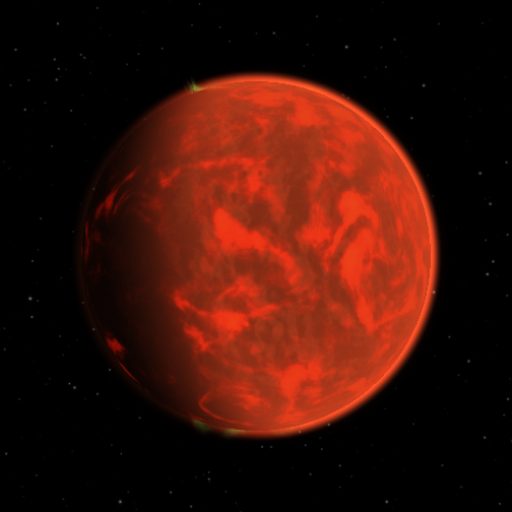
HD 219134 b
Also written HD 219134b
- Mass
- 4.74 × Earth
- Radius
- 1.60 × Earth
- Gravity
- 1.85 g
- Surface (est.)
- 1,027 K
- Year
- 3.1 days
- From Earth
- 21.3 ly
- Mass
- 4.74 × Earth
- Radius
- 1.60 × Earth
- Gravity
- 1.85 g
- Surface (est.)
- 1,027 K
- Year
- 3.1 days
- From Earth
- 21.3 ly
HD 219134 system
- Type
- K-type (Orange)
- Spectral type
- K3 V
- Temperature
- 4,699 K
- Radius
- 0.778 ☉
- Mass
- 0.81 ☉
- Planets
- 7
- Luminosity
- 0.265 ☉
Published by the NASA Exoplanet Archive. This world’s temperature and habitability score are computed from this star’s measured luminosity, not from a stand-in for its class.
 HD 219134 b0.039 AUYou are here4.7 M⊕
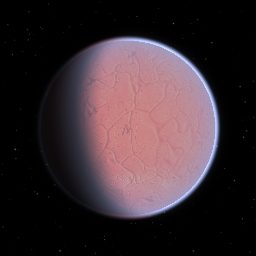
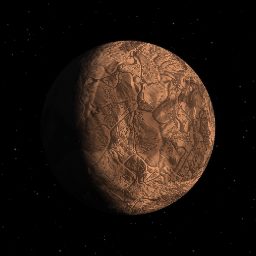
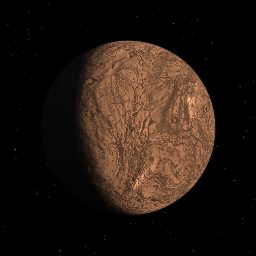
Star and planets drawn to scale: the star is 53 times as wide as HD 219134 b, so only its edge is in view. Orbits spaced as in the star system view.
Estimated: this planet doesn't transit its star, so its size is inferred, not measured
HD 219134 b is a rocky super-Earth that, when it was found in 2015, was the closest known planet to cross in front of its star. HD 219134 is an orange dwarf star, a little smaller and cooler than the Sun, about 21 light-years away and bright enough to see without a telescope from a dark site. HD 219134 b orbits it every 3.09 days.
Surface. Molten surface with lava flows, volcanic activity everywhere


Vaporized rock and metals
Atmosphere present but composition not ideal for lifePhysical Properties
Time Dilation
Clocks run 8.4 seconds per year slower than deep space — about 11 minutes over a lifetimeElemental Composition
How TerraForge built this world
HD 219134 b, from the NASA Exoplanet Archive (found 2015). Measured: 4.74 Earth masses, 0.0388 AU, a 4699 K K-type star. Composition inferred from an estimated bulk density of 1.16x Earth's, modeled rather than measured since this isn't a transiting planet — the radius is the archive's estimate, so it can't settle how much water there is; read as rock and iron, with a day locked to its 3.1-day year, as anything orbiting this close would be.