Habitability
0/ 100
View planet
View star system
View surface
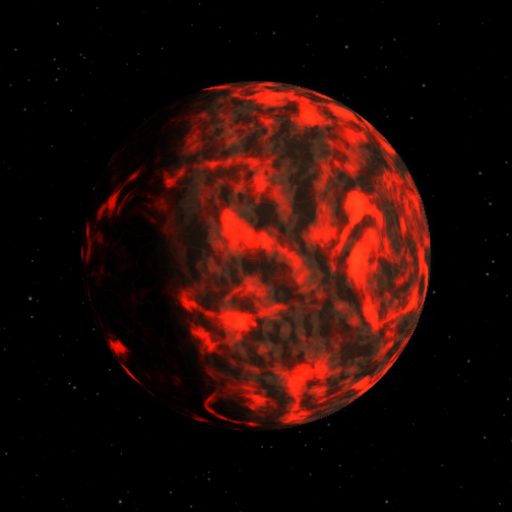
HD 80653 b
Also written HD 80653b
Lava World359 light years awayFound 2020
- Mass
- 5.61 × Earth
- Radius
- 1.62 × Earth
- Gravity
- 2.14 g
- Surface (est.)
- 2,438 K
- Year
- 17.3 hrs
- From Earth
- 359 ly
- Mass
- 5.61 × Earth
- Radius
- 1.62 × Earth
- Gravity
- 2.14 g
- Surface (est.)
- 2,438 K
- Year
- 17.3 hrs
- From Earth
- 359 ly
HD 80653 system
- Type
- G-type (Yellow (Sun-like))
- Spectral type
- G0 V
- Temperature
- 5,959 K
- Radius
- 1.2 ☉
- Mass
- 1.15 ☉
- Planets
- 2
- Luminosity
- 1.63 ☉
Published by the NASA Exoplanet Archive. This world’s temperature and habitability score are computed from this star’s measured luminosity, not from a stand-in for its class.
 HD 80653 b0.017 AUYou are here5.6 M⊕
Habitable zone
Star and planets drawn to scale: the star is 81 times as wide as HD 80653 b, so only its edge is in view. Orbits spaced as in the star system view.
HD 80653 b, from the NASA Exoplanet Archive (found 2020). Measured: 5.61 Earth masses, 0.0166 AU, a 5959 K G-type star. Composition inferred from a measured bulk density of 1.32x Earth's, which is rock and iron, with a day locked to its 0.7-day year, as anything orbiting this close would be.
Surface. Molten surface with lava flows, volcanic activity everywhere
Lava World
Magnetic FieldExtreme Activity
Lava worlds orbit so close to their stars that rocky surfaces melt into oceans of molten rock. Recent planet formation can also create temporary lava worlds.
Classification Criteria:
✓ Temperature: 2438K (>1000K)



Habitability ScoreUninhabitable
Contributing Factors
temperature0
Inferno world - temperatures exceed all possibility of life
atmosphere10
Minimal - too hot to retain
No atmosphere - exposed to radiation and temperature extremeswater8
Limited water content - boiling away, little would be retained
magnetic Field100
Magnetic field provides radiation protection
geology40
Extreme volcanic activity may be hazardous
Organic Chemistry80
Core organic elements (CHNO) present
rotation100
Optimal rotation period - balanced day/night cycle, moderate weather, and good heat distribution
Physical Properties
Mass
5.61x Earth (3.35e+25 kg)Radius
1.78x Earth (11,320 km)Surface Gravity
1.78x Earth (17.4 m/s²)Surface Temperature
2,438 K (2,165 °C / 3,929 °F)Rotation Period
17.3 hours/day (faster than Earth)