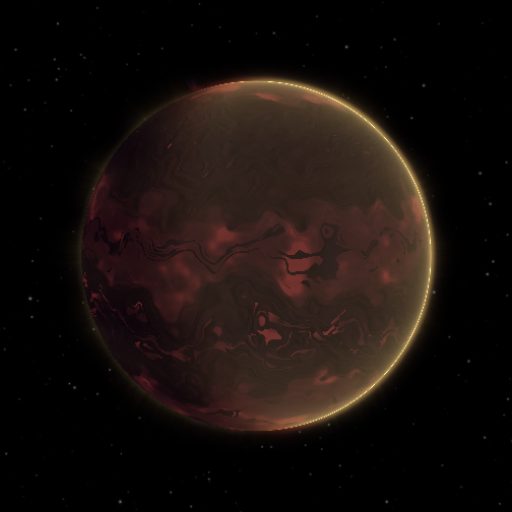
HD 93351 c
Also written HD 93351c
- Mass
- 4150.00 × Earth
- Radius
- 12.30 × Earth
- Gravity
- 27.43 g
- Surface (est.)
- 352 K
- Year
- 38.3 years
- From Earth
- 183 ly
- Mass
- 4150.00 × Earth
- Radius
- 12.30 × Earth
- Gravity
- 27.43 g
- Surface (est.)
- 352 K
- Year
- 38.3 years
- From Earth
- 183 ly
HD 93351 system
- Type
- G-type (Yellow (Sun-like))
- Temperature
- 5,408 K
- Radius
- 0.911 ☉
- Mass
- 0.94 ☉
- Planets
- 2
- Luminosity
- 0.640 ☉
Published by the NASA Exoplanet Archive. This world’s temperature and habitability score are computed from this star’s measured luminosity, not from a stand-in for its class.
 HD 93351 c11.20 AUYou are here4,150 M⊕
Star and planets drawn to scale: the star is 8.1 times as wide as HD 93351 c, so only its edge is in view. Orbits spaced as in the star system view.
Estimated: this planet doesn't transit its star, so its size is inferred, not measured
HD 93351 c, from the NASA Exoplanet Archive (found 2022). Measured: 4150 Earth masses, 11.2 AU, a 5408 K G-type star. Composition inferred from a mass of 4150 Earths, which is giant territory whatever its 2.23x density suggests, with an assumed 24-hour day — rotation cannot be measured for exoplanets. Note: TerraForge comes out at 352 K against the archive's 75 K, because that figure is the planet's own heat, not the star's. It receives almost no sunlight out at this distance and is still glowing from its formation — TerraForge only warms worlds with starlight, so it has no way to model a planet heated from within.
Surface. No surface: the coldest class of failed star, barely warmer than a summer day and glowing only in the infrared


Cold hydrogen and helium with ammonia and water clouds
Hydrogen-rich atmosphere typical of gas giants