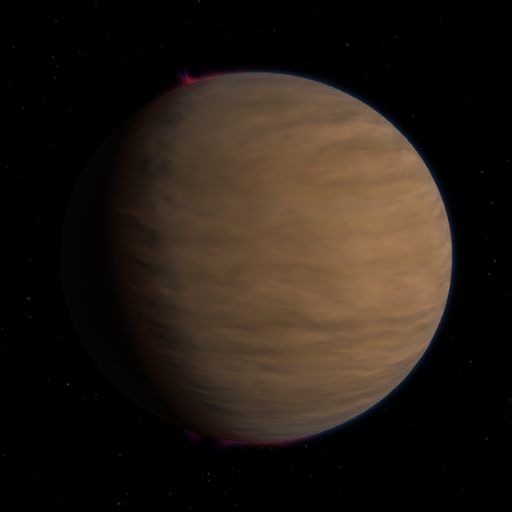
HIP 18918 b
Also written HIP 18918b
- Mass
- 76.30 × Earth
- Radius (est.)
- 10.40 × Earth
- Gravity (est.)
- 0.71 g
- Surface (est.)
- 269 K
- Year
- 108 days
- From Earth
- 127 ly
- Mass
- 76.30 × Earth
- Radius (est.)
- 10.40 × Earth
- Gravity (est.)
- 0.71 g
- Surface (est.)
- 269 K
- Year
- 108 days
- From Earth
- 127 ly
HIP 18918 system
- Type
- K-type (Orange)
- Spectral type
- K5V
- Temperature
- 4,572 K
- Radius
- 0.626 ☉
- Mass
- 0.7 ☉
- Planets
- 1
- Luminosity
- 0.154 ☉
Published by the Extrasolar Planets Encyclopaedia. This world’s temperature and habitability score are computed from its star’s published radius and temperature.
 HIP 18918 b0.42 AUYou are here76 M⊕
Star and planets drawn to scale: the star is 6.6 times as wide as HIP 18918 b, so only its edge is in view. Orbits spaced as in the star system view.
Estimated: this planet doesn't transit its star, so its size is inferred, not measured
HIP 18918 b, from the Extrasolar Planets Encyclopaedia (found 2026). Measured: 76.3 Earth masses, 0.42 AU, a 4572 K K-type star. Composition inferred from a mass of 76.3 Earths, which is giant territory whatever its 0.07x density suggests, with an assumed 10-hour day, typical of giant planets (Jupiter 9.9 h) — rotation cannot be measured for exoplanets.
Surface. No solid surface - thick gaseous envelope with possible rocky core deep within

Hydrogen and helium dominated with trace methane and ammonia
Hydrogen-rich atmosphere typical of gas giants