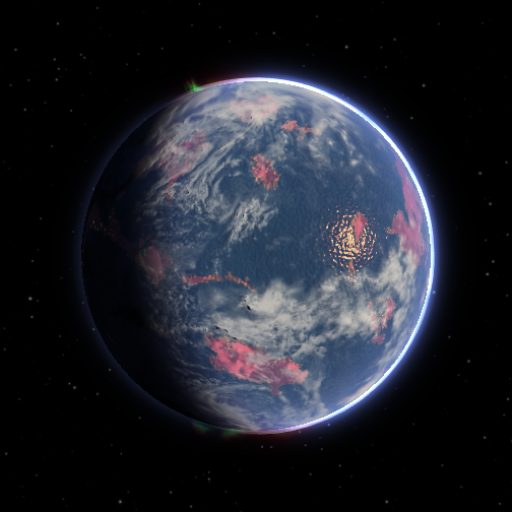
K2-72 e
Also written K2-72e, K2 72e, K2 72 e
- Mass
- 2.21 × Earth
- Radius
- 1.29 × Earth
- Gravity
- 1.33 g
- Surface (est.)
- 305 K
- Year
- 24.2 days
- From Earth
- 217 ly
- Mass
- 2.21 × Earth
- Radius
- 1.29 × Earth
- Gravity
- 1.33 g
- Surface (est.)
- 305 K
- Year
- 24.2 days
- From Earth
- 217 ly
K2-72 system
- Type
- M-type (Red Dwarf)
- Temperature
- 3,360 K
- Radius
- 0.331 ☉
- Mass
- 0.271 ☉
- Planets
- 4
- Luminosity
- 0.0146 ☉
Published by the NASA Exoplanet Archive. This world’s temperature and habitability score are computed from this star’s measured luminosity, not from a stand-in for its class.
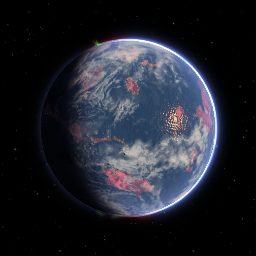
Star and planets drawn to scale: the star is 28 times as wide as K2-72 e, so only its edge is in view. Orbits spaced as in the star system view.
K2-72 e is a planet a little larger than Earth that orbits within the habitable zone of its star, the range of distances where liquid water could last on a surface. It is the outermost of four planets around K2-72, a red dwarf about 220 light-years away, and passes in front of the star every 24.2 days.
Surface. Rocky surface with continents, oceans, and active plate tectonics. Diverse biomes if life present.
✓ Conditions could support life. This planet’s modelled conditions could support biological processes: stable temperatures, liquid water and the chemistry life as we know it needs. That makes life possible, not present.


Nitrogen-oxygen atmosphere with trace CO₂, water vapor, and argon
Nitrogen-oxygen atmosphere - breathable and protectivePhysical Properties
Elemental Composition
How TerraForge built this world
K2-72 e, from the NASA Exoplanet Archive (found 2016). Measured: 2.21 Earth masses, 0.106 AU, a 3360 K M-type star. Composition inferred from a measured bulk density of 1.03x Earth's at this size, suggesting roughly 7% water/ice by mass, with an assumed 24-hour day — rotation cannot be measured for exoplanets.