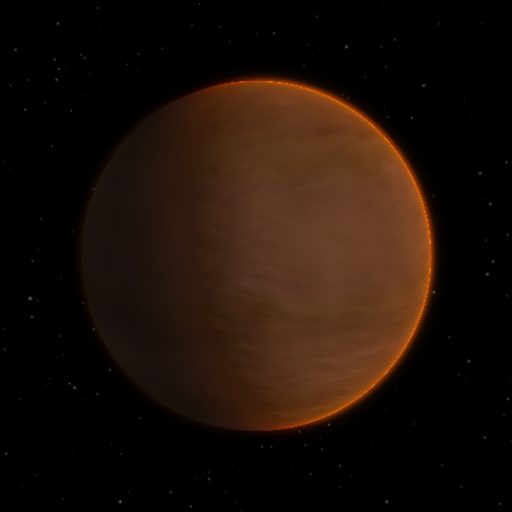
Kepler-1048 b
Also written Kepler-1048b, Kepler 1048b, Kepler 1048 b
- Mass
- 3.22 × Earth
- Radius
- 1.61 × Earth
- Gravity
- 1.24 g
- Surface (est.)
- 918 K
- Year
- 6.9 days
- From Earth
- 1,813 ly
- Mass
- 3.22 × Earth
- Radius
- 1.61 × Earth
- Gravity
- 1.24 g
- Surface (est.)
- 918 K
- Year
- 6.9 days
- From Earth
- 1,813 ly
Kepler-1048 system
- Type
- K-type (Orange)
- Temperature
- 4,651 K
- Radius
- 0.7 ☉
- Mass
- 0.75 ☉
- Planets
- 1
- Luminosity
- 0.390 ☉
Published by the NASA Exoplanet Archive. This world’s temperature and habitability score are computed from this star’s measured luminosity, not from a stand-in for its class.
 Kepler-1048 b0.059 AUYou are here≈3.2 M⊕
Star and planets drawn to scale: the star is 47 times as wide as Kepler-1048 b, so only its edge is in view. Orbits spaced as in the star system view.
Estimated: this planet's mass hasn't been measured, so it's estimated from its size
Kepler-1048 b, from the NASA Exoplanet Archive (found 2016). Measured: 3.22 Earth masses, 0.059 AU, a 4651 K K-type star. Composition inferred from an estimated bulk density of 0.77x Earth's — an envelope can't be inferred from estimated figures, so it is read as rock and iron, with a day locked to its 6.9-day year: at this distance its star would have stopped its spin within a million years. Note: TerraForge comes out at 918 K against the archive's 619 K, because the two make different assumptions about how much light the planet reflects and how its atmosphere holds and spreads heat.
Surface. Rocky surface with impact craters, possible volcanic features


Thin CO₂ and nitrogen atmosphere
Nitrogen atmosphere provides protection but not breathable (its active star has stripped much of its air over 4 billion years)