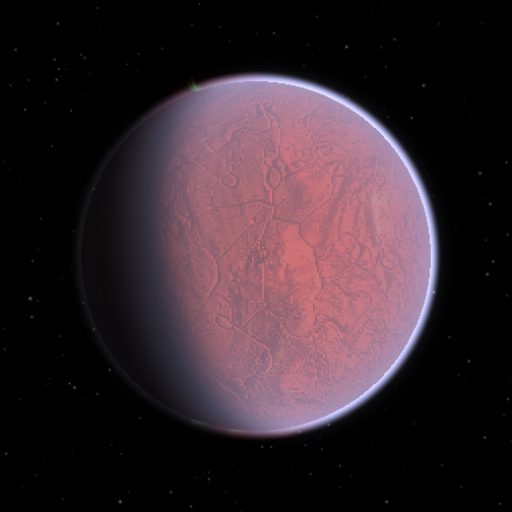
Kepler-1319 b
Also written Kepler-1319b, Kepler 1319b, Kepler 1319 b
- Mass
- 2.36 × Earth
- Radius
- 1.34 × Earth
- Gravity
- 1.31 g
- Surface (est.)
- 724 K
- Year
- 2.9 days
- From Earth
- 339 ly
- Mass
- 2.36 × Earth
- Radius
- 1.34 × Earth
- Gravity
- 1.31 g
- Surface (est.)
- 724 K
- Year
- 2.9 days
- From Earth
- 339 ly
Kepler-1319 system
- Type
- M-type (Red Dwarf)
- Temperature
- 3,655 K
- Radius
- 0.54 ☉
- Mass
- 0.56 ☉
- Planets
- 1
- Luminosity
- 0.0349 ☉
Published by the NASA Exoplanet Archive. This world’s temperature and habitability score are computed from this star’s measured luminosity, not from a stand-in for its class.
 Kepler-1319 b0.030 AUYou are here2.4 M⊕
Star and planets drawn to scale: the star is 44 times as wide as Kepler-1319 b, so only its edge is in view. Orbits spaced as in the star system view.
Kepler-1319 b, from the NASA Exoplanet Archive (found 2016). Measured: 2.36 Earth masses, 0.0296 AU, a 3655 K M-type star. Composition inferred from a measured bulk density of 0.98x Earth's at this size, suggesting roughly 11% water/ice by mass, with a day locked to its 2.9-day year, as anything orbiting this close would be. Note: TerraForge comes out at 724 K against the archive's 557 K, because it models stars by spectral class, and Kepler-1319 is not an average M-type.
Surface. Rocky surface with impact craters, possible volcanic features


Thin CO₂ and nitrogen atmosphere
Nitrogen atmosphere provides protection but not breathable