
Kepler-1483 b
Also written Kepler-1483b, Kepler 1483b, Kepler 1483 b
- Mass
- 2.92 × Earth
- Radius
- 1.52 × Earth
- Gravity
- 1.26 g
- Surface (est.)
- 1,142 K
- Year
- 9.5 days
- From Earth
- 4,142 ly
- Mass
- 2.92 × Earth
- Radius
- 1.52 × Earth
- Gravity
- 1.26 g
- Surface (est.)
- 1,142 K
- Year
- 9.5 days
- From Earth
- 4,142 ly
Kepler-1483 system
- Type
- F-type (White)
- Temperature
- 6,337 K
- Radius
- 1.4 ☉
- Mass
- 1.25 ☉
- Planets
- 1
- Luminosity
- 2.48 ☉
Published by the NASA Exoplanet Archive. This world’s temperature and habitability score are computed from this star’s measured luminosity, not from a stand-in for its class.
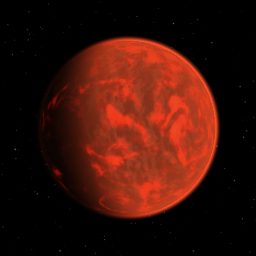 Kepler-1483 b0.096 AUYou are here2.9 M⊕
Star and planets drawn to scale: the star is 101 times as wide as Kepler-1483 b, so only its edge is in view. Orbits spaced as in the star system view.
Lava World, likely · its density could also fit a sub-Neptune
Kepler-1483 b, from the NASA Exoplanet Archive (found 2016). Measured: 2.92 Earth masses, 0.0958 AU, a 6337 K F-type star. Composition inferred from a measured bulk density of 0.83x Earth's, a little low for bare rock but leaving room for too little gas to change what it is — read as rock and iron, with a day locked to its 9.5-day year, as anything orbiting this close would be.
Surface. Molten surface with lava flows, volcanic activity everywhere



Vaporized rock and metals
Atmosphere present but composition not ideal for life (partially stripped by slow rotation)