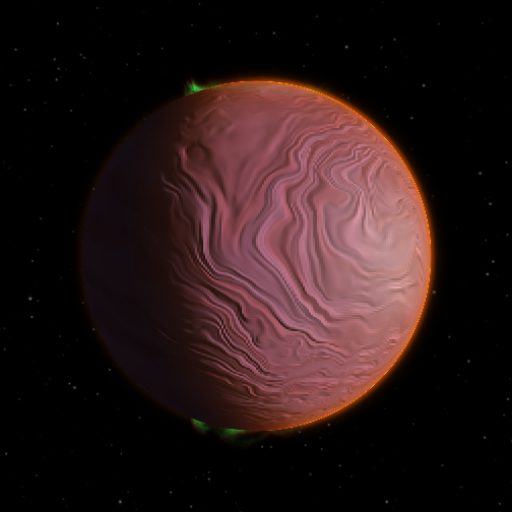
Kepler-155 c
Also written Kepler-155c, Kepler 155c, Kepler 155 c
- Mass
- 5.65 × Earth
- Radius
- 2.24 × Earth
- Gravity
- 1.13 g
- Surface (est.)
- 286 K
- Year
- 52.7 days
- From Earth
- 956 ly
- Mass
- 5.65 × Earth
- Radius
- 2.24 × Earth
- Gravity
- 1.13 g
- Surface (est.)
- 286 K
- Year
- 52.7 days
- From Earth
- 956 ly
Kepler-155 system
- Type
- K-type (Orange)
- Spectral type
- M0 V
- Temperature
- 4,508 K
- Radius
- 0.62 ☉
- Mass
- 0.635 ☉
- Planets
- 2
- Luminosity
- 0.0617 ☉
Published by the NASA Exoplanet Archive. This world’s temperature and habitability score are computed from this star’s measured luminosity, not from a stand-in for its class.
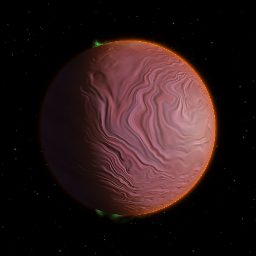 Kepler-155 c0.24 AUYou are here5.7 M⊕
Star and planets drawn to scale: the star is 30 times as wide as Kepler-155 c, so only its edge is in view. Orbits spaced as in the star system view.
Sub-Neptune, likely · its density could also fit a water world
Kepler-155 c is a planet about twice Earth's width, probably in the habitable zone of a cool star about 950 light-years away. The habitable zone is the range of distances where a planet could keep liquid water on its surface. It crosses in front of its star every 52.7 days and receives almost exactly as much light as Earth gets from the Sun, about 1.03 times as much, according to a 2017 analysis.
Surface. No solid surface - a hydrogen-helium envelope wrapped around a rocky core (a sub-Neptune)


Deep hydrogen-helium envelope with photochemical haze
Hydrogen-rich atmosphere typical of gas giantsPhysical Properties
Elemental Composition
How TerraForge built this world
Kepler-155 c, from the NASA Exoplanet Archive (found 2014). Measured: 5.65 Earth masses, 0.242 AU, a 4508 K K-type star. Composition inferred from a measured bulk density of 0.50x Earth's, too low for bare rock at this size, suggesting a rocky core under roughly a 3% hydrogen/helium envelope by mass, with an assumed 24-hour day — rotation cannot be measured for exoplanets.