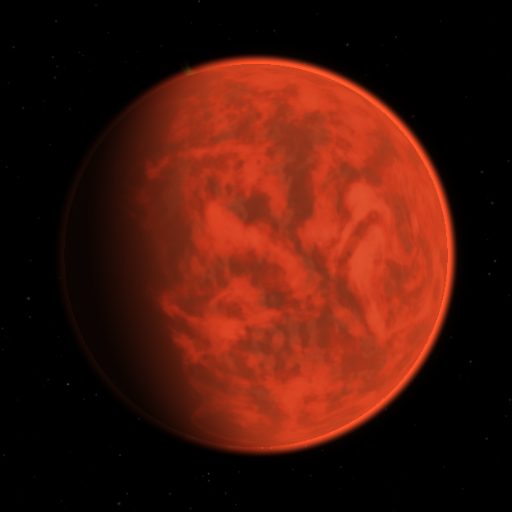
Kepler-1569 c
Also written Kepler-1569c, Kepler 1569c, Kepler 1569 c
- Mass
- 1.19 × Earth
- Radius
- 1.06 × Earth
- Gravity
- 1.06 g
- Surface (est.)
- 1,120 K
- Year
- 10.0 days
- From Earth
- 3,082 ly
- Mass
- 1.19 × Earth
- Radius
- 1.06 × Earth
- Gravity
- 1.06 g
- Surface (est.)
- 1,120 K
- Year
- 10.0 days
- From Earth
- 3,082 ly
Kepler-1569 system
- Type
- F-type (White)
- Spectral type
- F9/G0IV-V
- Temperature
- 6,088 K
- Radius
- 1.32 ☉
- Mass
- 1.14 ☉
- Planets
- 2
- Luminosity
- 2.16 ☉
Published by the Extrasolar Planets Encyclopaedia. This world’s temperature and habitability score are computed from its star’s published radius and temperature.
 Kepler-1569 c0.093 AUYou are here≈1.2 M⊕
Star and planets drawn to scale: the star is 136 times as wide as Kepler-1569 c, so only its edge is in view. Orbits spaced as in the star system view.
Estimated: this planet's mass hasn't been measured, so it's estimated from its size
Kepler-1569 c, from the Extrasolar Planets Encyclopaedia (found 2015). Measured: 1.19 Earth masses, 0.0927 AU, a 6088 K F-type star. Composition inferred from a estimated bulk density of 1.00x Earth's, which is rock and iron, with a day locked to its 10.0-day year, as it is predicted to be tidally locked: at this distance its star would have stopped its spin within a million years.
Surface. Molten surface with lava flows, volcanic activity everywhere


Vaporized rock and metals
Atmosphere present but composition not ideal for life (its active star has stripped much of its air)