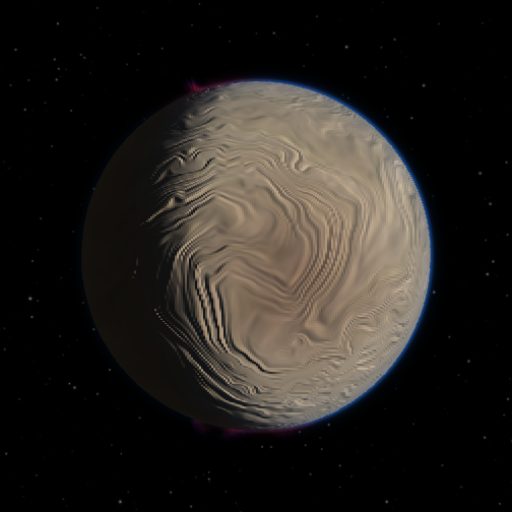
Kepler-16 b
Also written Kepler-16b, Kepler 16b, Kepler 16 b
- Mass
- 106.00 × Earth
- Radius
- 8.45 × Earth
- Gravity
- 1.48 g
- Surface (est.)
- 197 K
- Year
- 229 days
- From Earth
- 245 ly
- Mass
- 106.00 × Earth
- Radius
- 8.45 × Earth
- Gravity
- 1.48 g
- Surface (est.)
- 197 K
- Year
- 229 days
- From Earth
- 245 ly
Kepler-16 system
- Type
- K-type (Orange)
- Temperature
- 4,450 K
- Radius
- 0.649 ☉
- Mass
- 0.69 ☉
- Planets
- 1
- Luminosity
- 0.125 ☉
Published by the NASA Exoplanet Archive. This world’s temperature and habitability score are computed from this star’s measured luminosity, not from a stand-in for its class.
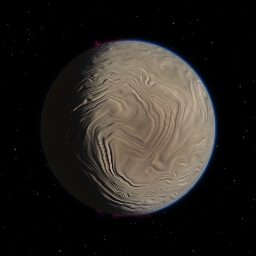 Kepler-16 b0.70 AUYou are here106 M⊕
Star and planets drawn to scale: the star is 8.4 times as wide as Kepler-16 b, so only its edge is in view. Orbits spaced as in the star system view.
Kepler-16 b was the first planet confirmed to transit, or pass in front of, a pair of stars. Announced in September 2011, it showed that planets can form and survive around binary stars, and it drew instant comparisons with Tatooine, the fictional desert world with two suns in Star Wars. NASA's Kepler space telescope saw it cross in front of both stars, on top of the regular dimming as the two stars eclipse each other. The study, led by Laurance Doyle of the SETI Institute, appeared in the journal Science.
Surface. No solid surface - thick gaseous envelope with possible rocky core deep within


Hydrogen and helium dominated with trace methane and ammonia
Hydrogen-rich atmosphere typical of gas giantsPhysical Properties
Elemental Composition
How TerraForge built this world
Kepler-16 b, from the NASA Exoplanet Archive (found 2011). Measured: 106 Earth masses, 0.705 AU, a 4450 K K-type star. Composition inferred from a mass of 106 Earths, which is giant territory whatever its 0.18x density suggests, with an assumed 24-hour day — rotation cannot be measured for exoplanets.