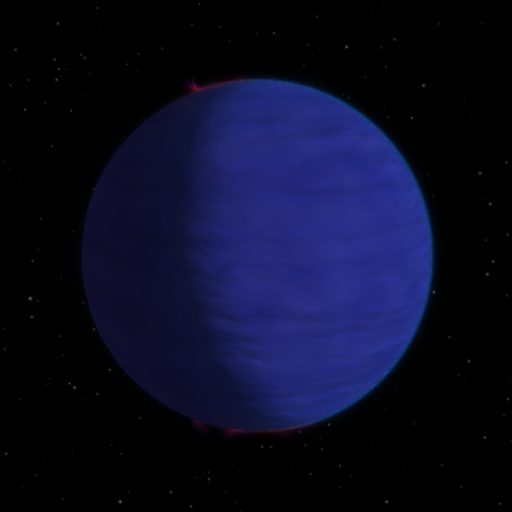
Kepler-1737 b
Also written Kepler-1737b, Kepler 1737b, Kepler 1737 b
- Mass
- 25.10 × Earth
- Radius
- 5.39 × Earth
- Gravity
- 0.86 g
- Surface (est.)
- 428 K
- Year
- 64.6 days
- Day (est.)
- 24.0 hrs
- Mass
- 25.10 × Earth
- Radius
- 5.39 × Earth
- Gravity
- 0.86 g
- Surface (est.)
- 428 K
- Year
- 64.6 days
- Day (est.)
- 24.0 hrs
Kepler-1737 system
- Type
- K-type (Orange)
- Temperature
- 5,043 K
- Radius
- 0.881 ☉
- Mass
- 0.834 ☉
- Planets
- 1
- Luminosity
- 0.453 ☉
Published by the NASA Exoplanet Archive. This world’s temperature and habitability score are computed from this star’s measured luminosity, not from a stand-in for its class.
 Kepler-1737 b0.30 AUYou are here25 M⊕
Star and planets drawn to scale: the star is 18 times as wide as Kepler-1737 b, so only its edge is in view. Orbits spaced as in the star system view.
Kepler-1737 b, from the NASA Exoplanet Archive (found 2021). Measured: 25.1 Earth masses, 0.297 AU, a 5043 K K-type star. Composition inferred from a measured bulk density of 0.16x Earth's, larger than even a pure water/ice world of this mass, suggesting a water-rich interior under roughly a 46% hydrogen/helium envelope by mass, with an assumed 24-hour day — rotation cannot be measured for exoplanets.
Surface. No solid surface - thick gaseous envelope with possible rocky core deep within


Hydrogen and helium dominated with trace methane and ammonia
Hydrogen-rich atmosphere typical of gas giants