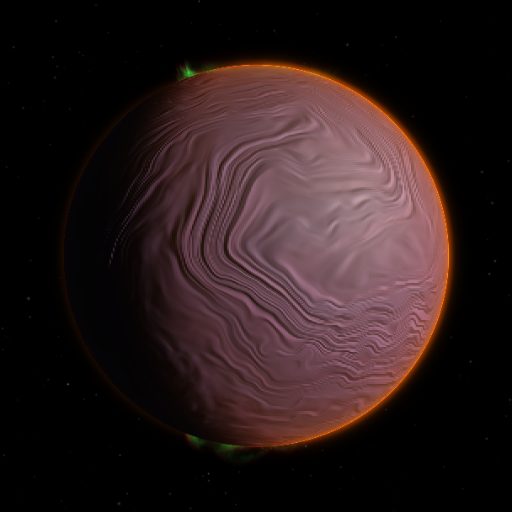
Kepler-1816 b
Also written Kepler-1816b, Kepler 1816b, Kepler 1816 b
- Mass (est.)
- 4.53 × Earth
- Radius
- 1.97 × Earth
- Gravity (est.)
- 1.17 g
- Surface (est.)
- 348 K
- Year
- 91.5 days
- From Earth
- 1,429 ly
- Mass (est.)
- 4.53 × Earth
- Radius
- 1.97 × Earth
- Gravity (est.)
- 1.17 g
- Surface (est.)
- 348 K
- Year
- 91.5 days
- From Earth
- 1,429 ly
Kepler-1816 system
- Type
- K-type (Orange)
- Temperature
- 5,051 K
- Radius
- 0.706 ☉
- Mass
- 0.786 ☉
- Planets
- 1
- Luminosity
- 0.294 ☉
Published by the NASA Exoplanet Archive. This world’s temperature and habitability score are computed from this star’s measured luminosity, not from a stand-in for its class.
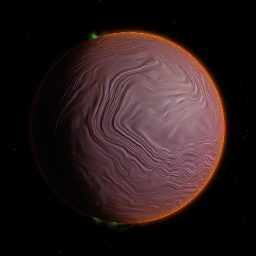 Kepler-1816 b0.36 AUYou are here≈4.5 M⊕
Star and planets drawn to scale: the star is 39 times as wide as Kepler-1816 b, so only its edge is in view. Orbits spaced as in the star system view.
Estimated: this planet's mass hasn't been measured, so it's estimated from its size
Kepler-1816 b, from the NASA Exoplanet Archive (found 2021). Measured: 4.53 Earth masses, 0.356 AU, a 5051 K K-type star. Composition inferred from a estimated bulk density of 0.59x Earth's, too low for bare rock at this size, suggesting a rocky core under roughly a 2% hydrogen/helium envelope by mass, with an assumed 17-hour day, typical of Neptune-like planets (Neptune 16 h) — rotation cannot be measured for exoplanets.
Surface. No solid surface - a hydrogen-helium envelope wrapped around a rocky core (a sub-Neptune)

Deep hydrogen-helium envelope with photochemical haze
Hydrogen-rich atmosphere typical of gas giants