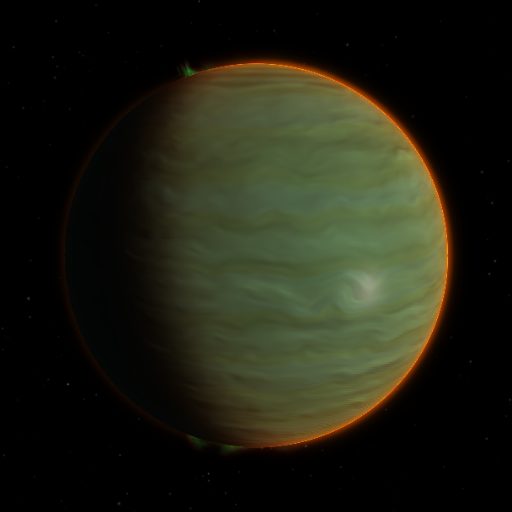
Kepler-296 d
Also written Kepler-296d, Kepler 296d, Kepler 296 d
- Mass (est.)
- 5.02 × Earth
- Radius
- 2.09 × Earth
- Gravity (est.)
- 1.15 g
- Surface (est.)
- 345 K
- Year
- 19.9 days
- From Earth
- 545 ly
- Mass (est.)
- 5.02 × Earth
- Radius
- 2.09 × Earth
- Gravity (est.)
- 1.15 g
- Surface (est.)
- 345 K
- Year
- 19.9 days
- From Earth
- 545 ly
Kepler-296 system
- Type
- K-type (Orange)
- Spectral type
- M2 V
- Temperature
- 3,740 K
- Radius
- 0.48 ☉
- Mass
- 0.498 ☉
- Planets
- 5
- Luminosity
- 0.0310 ☉
Published by the NASA Exoplanet Archive. This world’s temperature and habitability score are computed from this star’s measured luminosity, not from a stand-in for its class.
 Kepler-296 d0.12 AUYou are here≈5.0 M⊕
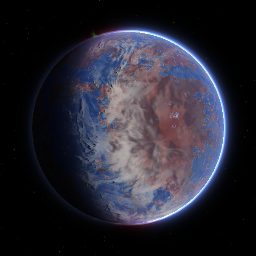
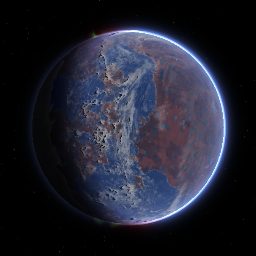
Star and planets drawn to scale: the star is 25 times as wide as Kepler-296 d, so only its edge is in view. Orbits spaced as in the star system view.
Estimated: this planet's mass hasn't been measured, so it's estimated from its size
Kepler-296 d is the largest of five planets around Kepler-296, a pair of red dwarfs about 550 light-years away. It is the third planet out, crossing in front of its star every 19.9 days, and NASA's Kepler space telescope measured its radius at about 2.1 times Earth's. It was found together with its four siblings by watching for the small dips in starlight as each planet passed in front of the star.
Surface. No solid surface - a hydrogen-helium envelope wrapped around a rocky core (a sub-Neptune)
Deep hydrogen-helium envelope with photochemical haze
Hydrogen-rich atmosphere typical of gas giantsPhysical Properties
Elemental Composition
How TerraForge built this world
Kepler-296 d, from the NASA Exoplanet Archive (found 2014). Measured: 5.02 Earth masses, 0.118 AU, a 3740 K K-type star. Composition inferred from a estimated bulk density of 0.55x Earth's, too low for bare rock at this size, suggesting a rocky core under roughly a 2% hydrogen/helium envelope by mass, with a day locked to its 19.9-day year, as it is predicted to be tidally locked: at this distance its star would have stopped its spin within 85 million years.