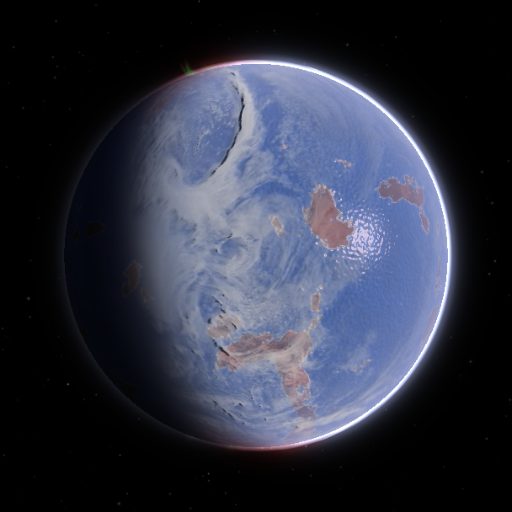
Kepler-395 c
Also written Kepler-395c, Kepler 395c, Kepler 395 c
- Mass (est.)
- 2.30 × Earth
- Radius
- 1.32 × Earth
- Gravity (est.)
- 1.32 g
- Surface (est.)
- 343 K
- Year
- 35.0 days
- From Earth
- 1,373 ly
- Mass (est.)
- 2.30 × Earth
- Radius
- 1.32 × Earth
- Gravity (est.)
- 1.32 g
- Surface (est.)
- 343 K
- Year
- 35.0 days
- From Earth
- 1,373 ly
Kepler-395 system
- Type
- K-type (Orange)
- Temperature
- 4,262 K
- Radius
- 0.556 ☉
- Mass
- 0.623 ☉
- Planets
- 2
- Luminosity
- 0.0640 ☉
Published by the NASA Exoplanet Archive. This world’s temperature and habitability score are computed from this star’s measured luminosity, not from a stand-in for its class.
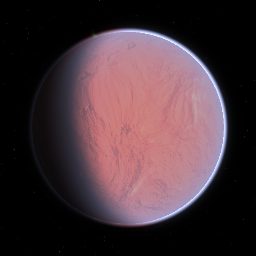
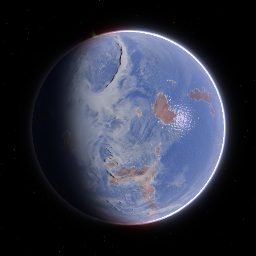 Kepler-395 c0.18 AUYou are here≈2.3 M⊕
Star and planets drawn to scale: the star is 46 times as wide as Kepler-395 c, so only its edge is in view. Orbits spaced as in the star system view.
Estimated: this planet's mass hasn't been measured, so it's estimated from its size
Surface. Rocky surface with continents, oceans, and active plate tectonics. Diverse biomes if life present.
✓ Conditions could support life. This planet’s modelled conditions could support biological processes: stable temperatures, liquid water and the chemistry life as we know it needs. That makes life possible, not present.

Nitrogen-oxygen atmosphere with trace CO₂, water vapor, and argon
Nitrogen-oxygen atmosphere - breathable and protectivePhysical Properties
Elemental Composition
How TerraForge built this world
Kepler-395 c, from the NASA Exoplanet Archive (found 2014). Measured: 2.3 Earth masses, 0.177 AU, a 4262 K K-type star. Composition inferred from a estimated bulk density of 1.00x Earth's at this size, suggesting roughly 10% water/ice by mass, with a day locked to its 35.0-day year, as it is predicted to be tidally locked: at this distance its star would have stopped its spin within 8 million years.