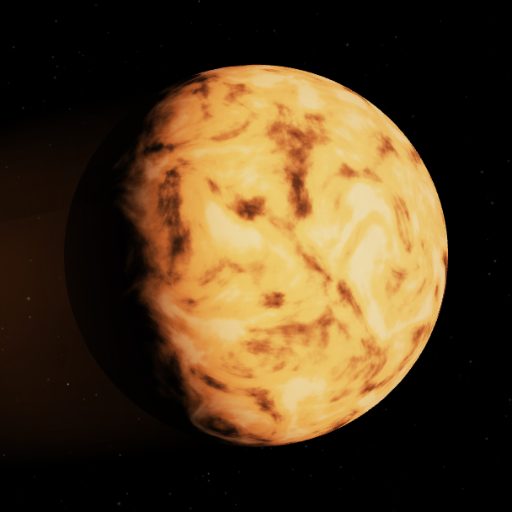
Kepler-469 b
Also written Kepler-469b, Kepler 469b, Kepler 469 b
- Mass
- 0.31 × Earth
- Radius
- 0.73 × Earth
- Gravity
- 0.59 g
- Surface (est.)
- 3,031 K
- Year
- 21.0 hrs
- From Earth
- 3,020 ly
- Mass
- 0.31 × Earth
- Radius
- 0.73 × Earth
- Gravity
- 0.59 g
- Surface (est.)
- 3,031 K
- Year
- 21.0 hrs
- From Earth
- 3,020 ly
Kepler-469 system
- Type
- G-type (Yellow (Sun-like))
- Spectral type
- G0IV
- Temperature
- 5,846 K
- Radius
- 2.19 ☉
- Mass
- 1.06 ☉
- Planets
- 1
- Luminosity
- 5.05 ☉
Published by the Extrasolar Planets Encyclopaedia. This world’s temperature and habitability score are computed from its star’s published radius and temperature.
 Kepler-469 b0.019 AUYou are here≈0.3 M⊕
Star and planets drawn to scale: the star is 328 times as wide as Kepler-469 b, so only its edge is in view. Orbits spaced as in the star system view.
Estimated: this planet's mass hasn't been measured, so it's estimated from its size
Kepler-469 b, from the Extrasolar Planets Encyclopaedia (found 2017). Measured: 0.314 Earth masses, 0.0189 AU, a 5846 K G-type star. Composition inferred from a estimated bulk density of 0.81x Earth's, which is rock and iron, with a day locked to its 0.9-day year, as it is predicted to be tidally locked: at this distance its star would have stopped its spin within a million years.
Surface. Molten surface with lava flows, volcanic activity everywhere


Minimal - too hot to retain
No atmosphere - exposed to radiation and temperature extremes (its active star has stripped much of its air)