Habitability
18/ 100
View planet
View star system
View surface
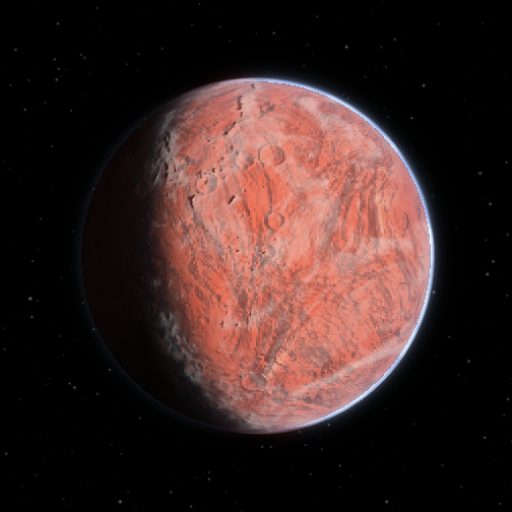
Kepler-538 Ac
Also written Kepler 538 Ac
Rocky Terrestrial509 light years awayFound 2019
- Mass
- 0.24 × Earth
- Radius
- 0.63 × Earth
- Gravity
- 0.61 g
- Surface (est.)
- 374 K
- Year
- 118 days
- From Earth
- 509 ly
- Mass
- 0.24 × Earth
- Radius
- 0.63 × Earth
- Gravity
- 0.61 g
- Surface (est.)
- 374 K
- Year
- 118 days
- From Earth
- 509 ly
Kepler-538 system
- Type
- G-type (Yellow (Sun-like))
- Spectral type
- G5V
- Temperature
- 5,534 K
- Radius
- 0.872 ☉
- Mass
- 0.892 ☉
- Planets
- 2
- Luminosity
- 0.642 ☉
Published by the Extrasolar Planets Encyclopaedia. This world’s temperature and habitability score are computed from its star’s published radius and temperature.
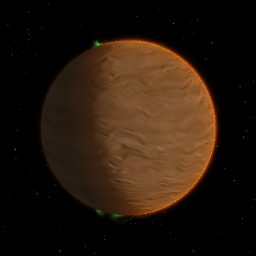
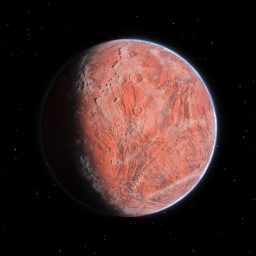 Kepler-538 Ac0.45 AUYou are here0.2 M⊕
Habitable zone
Star and planets drawn to scale: the star is 151 times as wide as Kepler-538 Ac, so only its edge is in view. Orbits spaced as in the star system view.
exoplanet.euListed by the Extrasolar Planets Encyclopaedia; not yet in NASA's confirmed catalogue.View on exoplanet.eu
Kepler-538 Ac, from the Extrasolar Planets Encyclopaedia (found 2019). Measured: 0.242 Earth masses, 0.45 AU, a 5534 K G-type star. Composition inferred from a measured bulk density of 0.97x Earth's, which is rock and iron, with an assumed 24-hour day — rotation cannot be measured for exoplanets.
Surface. Rocky surface with impact craters, possible volcanic features
Rocky Terrestrial
Life unlikely — too hot for liquid waterNone Activity
Rocky terrestrial planets are primarily composed of silicate rocks and metals. They're the most common type of small planet in the universe.
Classification Criteria:
✓ Silicon: 25.0% + Iron: 12.5% + Magnesium: 3.8%✓ Mass: 0.2x Earth (terrestrial range)


Habitability ScoreUninhabitable
Contributing Factors
temperature15
Extremely hot - hostile to known life forms
atmosphere70
Thin CO₂ and nitrogen atmosphere
Nitrogen atmosphere provides protection but not breathablewater25
Limited water content - likely as steam (low gravity lets water escape to space)
magnetic Field30
No magnetic field - vulnerable to solar radiation
geology30
Geologically dead - no nutrient recycling
Organic Chemistry80
Core organic elements (CHNO) present
rotation100
Optimal rotation period - balanced day/night cycle, moderate weather, and good heat distribution
Physical Properties
Mass
0.24x Earth (1.45e+24 kg)Radius
0.62x Earth (3,970 km)Surface Gravity
0.62x Earth (6.1 m/s²)Surface Temperature
374 K (100 °C / 213 °F)Rotation Period
24.0 hours/day