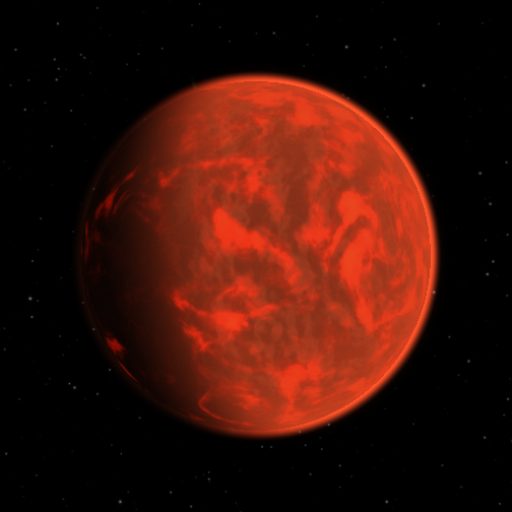
Kepler-770 d
Also written Kepler-770d, Kepler 770d, Kepler 770 d
- Mass
- 2.54 × Earth
- Radius
- 1.40 × Earth
- Gravity
- 1.30 g
- Surface (est.)
- 1,203 K
- Year
- 4.2 days
- From Earth
- 3,033 ly
- Mass
- 2.54 × Earth
- Radius
- 1.40 × Earth
- Gravity
- 1.30 g
- Surface (est.)
- 1,203 K
- Year
- 4.2 days
- From Earth
- 3,033 ly
Kepler-770 system
- Type
- G-type (Yellow (Sun-like))
- Temperature
- 5,598 K
- Radius
- 0.92 ☉
- Mass
- 0.94 ☉
- Planets
- 3
- Luminosity
- 1.13 ☉
Published by the NASA Exoplanet Archive. This world’s temperature and habitability score are computed from this star’s measured luminosity, not from a stand-in for its class.
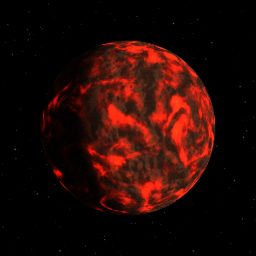
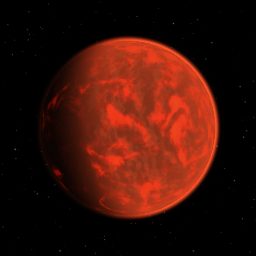
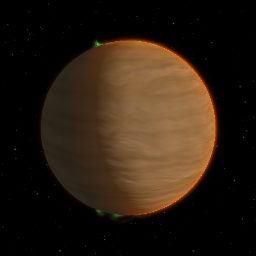
Star and planets drawn to scale: the star is 72 times as wide as Kepler-770 d, so only its edge is in view. Orbits spaced as in the star system view.
Lava World, likely · its density could also fit a sub-Neptune
Kepler-770 d, from the NASA Exoplanet Archive (found 2016). Measured: 2.54 Earth masses, 0.0616 AU, a 5598 K G-type star. Composition inferred from a measured bulk density of 0.93x Earth's at this size, suggesting roughly 16% water/ice by mass, with a day locked to its 4.2-day year, as anything orbiting this close would be. Note: TerraForge comes out at 1203 K against the archive's 1941 K, because it models stars by spectral class, and Kepler-770 is not an average G-type.
Surface. Molten surface with lava flows, volcanic activity everywhere



Vaporized rock and metals
Atmosphere present but composition not ideal for life