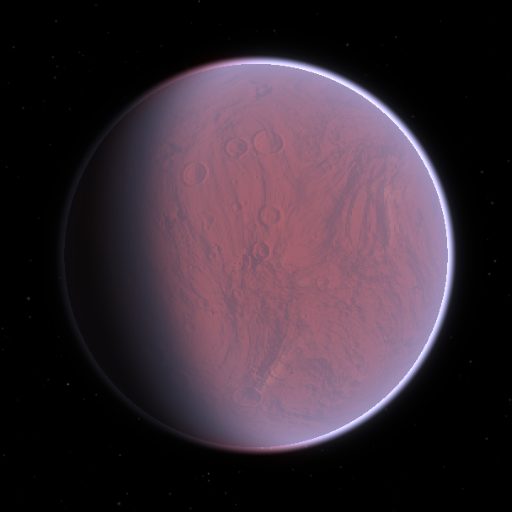
L 98-59 b
Also written L 98-59b, L 98 59b, L 98 59 b
- Mass
- 0.46 × Earth
- Radius
- 0.84 × Earth
- Gravity
- 0.66 g
- Surface (est.)
- 629 K
- Year
- 2.3 days
- From Earth
- 34.6 ly
- Mass
- 0.46 × Earth
- Radius
- 0.84 × Earth
- Gravity
- 0.66 g
- Surface (est.)
- 629 K
- Year
- 2.3 days
- From Earth
- 34.6 ly
L 98-59 system
- Type
- M-type (Red Dwarf)
- Spectral type
- M3 V
- Temperature
- 3,415 K
- Radius
- 0.316 ☉
- Mass
- 0.292 ☉
- Planets
- 6
- Luminosity
- 0.0122 ☉
Published by the NASA Exoplanet Archive. This world’s temperature and habitability score are computed from this star’s measured luminosity, not from a stand-in for its class.
 L 98-59 b0.022 AUYou are here0.5 M⊕
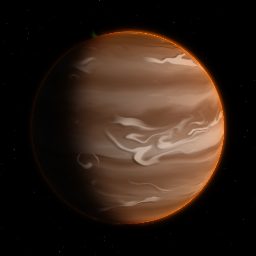
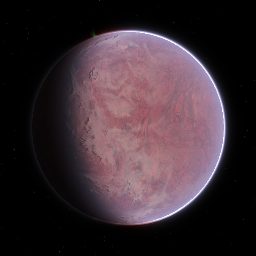
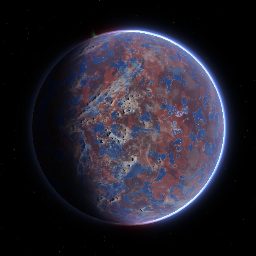
Star and planets drawn to scale: the star is 41 times as wide as L 98-59 b, so only its edge is in view. Orbits spaced as in the star system view.
L 98-59 b is smaller and lighter than Earth, and it may have an atmosphere made by volcanoes. It is the innermost of five planets around L 98-59, a bright red dwarf about 35 light-years away, and passes in front of its star every 2.25 days. NASA's TESS satellite found it in 2019 along with its siblings L 98-59 c and d, in a study led by Veselin Kostov. Watching those transits, the small dips in starlight as a planet crosses its star, gives a planet's size directly. L 98-59 b is about 0.84 times Earth's width.
Surface. Rocky surface with impact craters, possible volcanic features

Thin CO₂ and nitrogen atmosphere
Nitrogen atmosphere provides protection but not breathable (its active star has stripped much of its air over 4.9 billion years)Physical Properties
Time Dilation
Clocks run 6.3 seconds per year slower than deep space — about 8 minutes over a lifetimeElemental Composition
How TerraForge built this world
L 98-59 b, from the NASA Exoplanet Archive (found 2019). Measured: 0.46 Earth masses, 0.0223 AU, a 3415 K M-type star. Composition inferred from a measured bulk density of 0.78x Earth's at this size, suggesting roughly 7% water/ice by mass, with a day locked to its 2.3-day year, as it is predicted to be tidally locked: at this distance its star would have stopped its spin within a million years.