Create your free account

Enter your email and we'll send a 6-digit code — no password needed.
We only keep your email and the username you choose. We never share or sell your email, and we don't send marketing — we use it only to email you a sign-in code. Read our privacy policy.
Planet profiles

55 Cnc e

Lava World · 41 light-years away · Last reviewed October 14, 2026

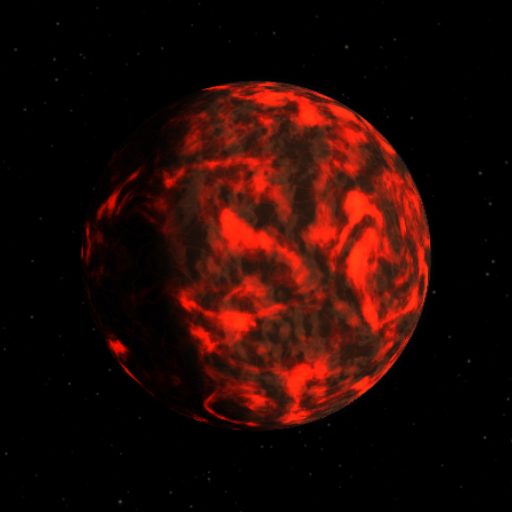
55 Cnc e rendered in TerraForge from its measured mass, orbit and star
TerraForge's rendering of 55 Cnc e, generated by our physics engine from its measured mass, size, orbit and star. An illustration of what the science suggests, not a photograph.
TerraForge classification
Lava World
Host star
55 Cnc (G8 V)
Distance
41 light-years
Orbit
0.74 days
Mass
7.99 × Earth
Radius
1.88 × Earth
Discovered
2004, radial velocity

Figures from the NASA Exoplanet Archive. The classification is TerraForge’s, from its physics model.

NASA calls the evidence for gas around 55 Cancri e the best yet for an atmosphere on a rocky planet beyond our Solar System. The planet, also named Janssen, was first detected in 2004 with the Hobby-Eberly Telescope at McDonald Observatory. That team used the radial velocity method, which measures the tiny wobble a planet's gravity causes in its star. They put its orbit at 2.8 days. In 2011, after other astronomers predicted a much shorter orbit, the MOST space telescope caught the planet passing in front of its star every 0.74 days, about 18 hours. The star is bright enough to see with the naked eye, which makes the planet unusually easy to study.

55 Cancri e is a super-Earth, a rocky planet larger than Earth: about 8 times Earth's mass and nearly twice its width. It orbits about 25 times closer to its star than Mercury is to the Sun. It is tidally locked, so one side is in permanent daylight. Its surface is thought to be an ocean of magma.

In 2024 a team led by Renyu Hu of NASA's Jet Propulsion Laboratory used the James Webb Space Telescope's NIRCam and MIRI instruments to measure the infrared glow of the day side. Bare rock there should reach about 2,200 °C. Webb measured about 1,540 °C, which suggests an atmosphere is carrying heat away. The light also showed a dip consistent with carbon dioxide or carbon monoxide. The team proposes this gas bubbles out of the magma ocean and is constantly replenished.

The picture is not settled. A second Webb study, led by J. A. Patel and published the same year, watched five eclipses, when the planet passes behind its star. The planet's brightness changed sharply between visits, from undetectable to strong. Some visits favoured a thin carbon-rich atmosphere, others a thin vapour of rock, and some showed no clear signal. The authors suggest gas may be released in bursts, or that a patchy cloud of volcanic dust circling the star is involved. Which gas dominates, and whether the atmosphere is stable, remain open questions.

TerraForge's model, working only from its mass, orbit and star, classifies 55 Cancri e as a lava world, which fits the magma-ocean picture. It cannot capture an atmosphere that may come and go, and its modelled 2,000 K is a little hotter than the roughly 1,800 K that Hu's team measured on the day side.

Sources

  1. Detection of a NEPTUNE-mass planet in the ρ1 Cancri system using the Hobby-Eberly Telescope — The Astrophysical Journal Letters (arXiv:astro-ph/0408585)
  2. A Super-Earth Transiting a Naked-Eye Star — The Astrophysical Journal Letters (arXiv:1104.5230)
  3. A secondary atmosphere on the rocky exoplanet 55 Cancri e — Nature (arXiv:2405.04744)
  4. NASA's Webb Hints at Possible Atmosphere Surrounding Rocky Exoplanet — NASA Jet Propulsion Laboratory
  5. JWST reveals the rapid and strong day-side variability of 55 Cancri e — Astronomy & Astrophysics (arXiv:2407.12898)
A banded gas giant with four moons in different colors: a yellow sulfur moon, two rust-red rock moons and a blue water moon

New: Choose What Your Moons Are Made Of 🌙

Every moon used to be grey rock, white ice or blue ocean, decided for you. Now each one has a "Made of" choice in the builder's Moons tab — silicate rock, iron, water ice, carbon, sulfur, or nitrogen and methane ice — and the physics decides what that becomes. Put water ice too close to the star and it boils off to bare rock. Put sulfur where a neighbouring moon keeps it tidally flexed and it erupts in Io's yellows. Give a Titan-sized moon nitrogen ice far from the sun and it wraps itself in haze. Hang a water moon about the mass of Earth off a giant planet in the habitable zone and it can hold air and open seas — scored for life on the same scale as a planet, with a day as long as its orbit. A tint slider nudges the colour, but only as far as that material could really go.

Create your free account

Enter your email and we'll send a 6-digit code — no password needed.
We only keep your email and the username you choose. We never share or sell your email, and we don't send marketing — we use it only to email you a sign-in code. Read our privacy policy.

Send feedback

We're still building out the best experience we can — and we'd love your input. Tell us about features you enjoy, ideas you'd like to see, or pain points where something feels off, and we'll know where to look next.

Type
Idea
Bug
Pain point
Other