Create your free account

Enter your email and we'll send a 6-digit code — no password needed.
We only keep your email and the username you choose. We never share or sell your email, and we don't send marketing — we use it only to email you a sign-in code. Read our privacy policy.
Planet profiles

eps Eri b

Gas Giant · 10 light-years away · Last reviewed October 14, 2026

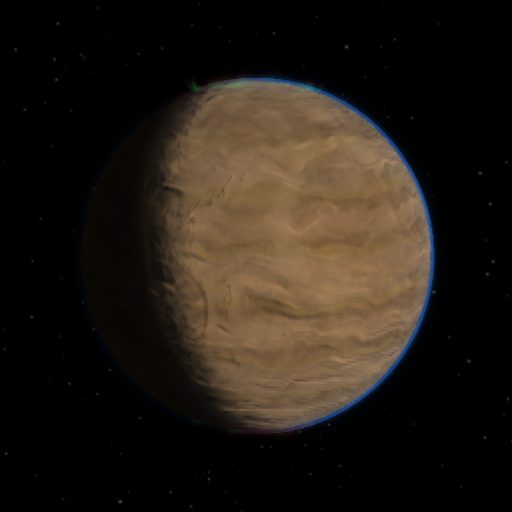
eps Eri b rendered in TerraForge from its measured mass, orbit and star
TerraForge's rendering of eps Eri b, generated by our physics engine from its measured mass, size, orbit and star. An illustration of what the science suggests, not a photograph.
TerraForge classification
Gas Giant
Host star
eps Eri (K2 V)
Distance
10 light-years
Orbit
2,680 days
Mass
318 × Earth
Radius
13.8 × Earth
Discovered
2000, radial velocity

Figures from the NASA Exoplanet Archive. The classification is TerraForge’s, from its physics model.

A study posted in September 2026 calls Epsilon Eridani b the nearest Jupiter analogue known, a giant planet orbiting at roughly the distance of our own asteroid belt from the Sun. Its star is just 10.4 light-years away. The first strong claim for the planet came in 2000 from a team led by Artie Hatzes. They combined 20 years of radial velocity data, which track the tiny wobble a planet's gravity causes in its star, from four different telescopes.

The claim was hard to trust. Epsilon Eridani is magnetically active, and activity can mimic a planet's tug. Hatzes's team argued the star's activity cycles, at about 3 and 20 years, did not match the planet's signal. Doubts lingered until 2019, when a team led by Dimitri Mawet confirmed the planet using 30 years of radial velocity data. They found about 0.78 times Jupiter's mass and a 7.4-year orbit 3.5 AU from the star, where 1 AU is the Earth–Sun distance. The orbit is nearly circular, ten times less stretched than the first estimate suggested.

No one has yet photographed it. Mawet's team searched with an infrared camera and a coronagraph, a device that blocks a star's glare, on the Keck telescope and found nothing. A 2025 search with the James Webb Space Telescope's NIRCam coronagraph also found no significant signal, though it ruled out Saturn-mass planets beyond about 16 AU. That search also looked for a second planet that may shape the star's outer ring of dust.

Because the planet has only been sensed through its pull, its size, temperature and atmosphere have not been measured. Mass estimates also vary: the 2026 study, combining radial velocities, precise star positions and Webb's limits, finds 0.91 Jupiter masses. It predicts that the coronagraph on NASA's upcoming Roman Space Telescope should see the planet in reflected light if it has clouds.

TerraForge's model, working only from its mass, orbit and star, classifies Epsilon Eridani b as a gas giant, which agrees with its measured mass. Its modelled 117 K is close to the archive's 112 K equilibrium temperature, but no direct measurement exists yet to test either figure.

Sources

  1. Evidence for a Long-period Planet Orbiting Epsilon Eridani — The Astrophysical Journal Letters (arXiv:astro-ph/0009423)
  2. Deep exploration of ε Eridani with Keck Ms-band vortex coronagraphy and radial velocities: mass and orbital parameters of the giant exoplanet — The Astronomical Journal (arXiv:1810.03794)
  3. Searching for Planets Orbiting ε Eridani with JWST/NIRCam — The Astronomical Journal (arXiv:2508.08463)
  4. An Updated Model for Epsilon Eridani b and Prospects for Imaging with the Roman Coronagraph — arXiv:2609.19131 (preprint)
A banded gas giant with four moons in different colors: a yellow sulfur moon, two rust-red rock moons and a blue water moon

New: Choose What Your Moons Are Made Of 🌙

Every moon used to be grey rock, white ice or blue ocean, decided for you. Now each one has a "Made of" choice in the builder's Moons tab — silicate rock, iron, water ice, carbon, sulfur, or nitrogen and methane ice — and the physics decides what that becomes. Put water ice too close to the star and it boils off to bare rock. Put sulfur where a neighbouring moon keeps it tidally flexed and it erupts in Io's yellows. Give a Titan-sized moon nitrogen ice far from the sun and it wraps itself in haze. Hang a water moon about the mass of Earth off a giant planet in the habitable zone and it can hold air and open seas — scored for life on the same scale as a planet, with a day as long as its orbit. A tint slider nudges the colour, but only as far as that material could really go.

Create your free account

Enter your email and we'll send a 6-digit code — no password needed.
We only keep your email and the username you choose. We never share or sell your email, and we don't send marketing — we use it only to email you a sign-in code. Read our privacy policy.

Send feedback

We're still building out the best experience we can — and we'd love your input. Tell us about features you enjoy, ideas you'd like to see, or pain points where something feels off, and we'll know where to look next.

Type
Idea
Bug
Pain point
Other