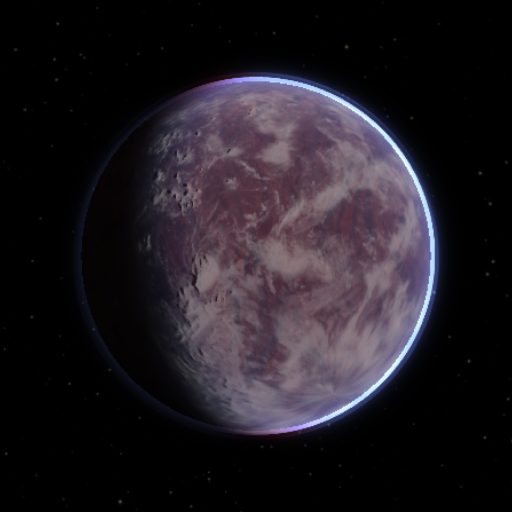
GJ 1061 c is the heaviest of the three planets around GJ 1061, a small red dwarf about 12 light-years away and one of the 20 nearest stars to the Sun. It circles its star every 6.68 days and has a mass of about 1.76 Earth masses. It was discovered together with GJ 1061 b and d, announced by the Red Dots team led by Stefan Dreizler in 2019 and published in 2020.
The team found all three using the radial velocity method, which picks up the slight back-and-forth motion a planet's gravity gives its star, after three months of nightly measurements with the HARPS spectrograph. GJ 1061 c sits in the middle of the system: its orbit takes about twice as long as b's and about half as long as d's. Because of that near-resonance, the planets tug on each other enough to show up in the data. In 2025 the team combined new ESPRESSO measurements with years of monitoring and used those tugs to measure true masses instead of only minimum masses, assuming the orbits share one plane.
The 2025 study found all three planets potentially rocky, with equilibrium temperatures, set by starlight alone, ranging from about 360 kelvin for the innermost to about 240 kelvin for the outermost. GJ 1061 c falls between them; according to the NASA Exoplanet Archive it receives about 1.4 times the starlight Earth gets from the Sun. Whether it has air or water is unknown. None of the planets has been seen crossing in front of the star, so their sizes have not been measured. The authors call the system a prime target for future instruments able to detect planetary atmospheres directly.