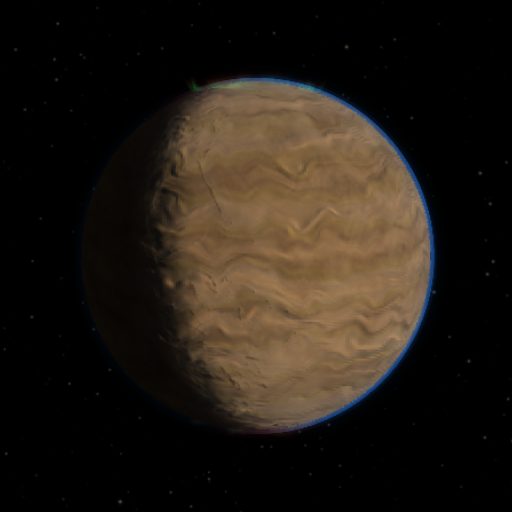
GJ 15 A c is a cold giant planet on a very long orbit. When it was reported in 2018, it was the longest-period planet lighter than Jupiter ever found by the radial velocity method, which detects planets from the slight back-and-forth motion their gravity gives a star. It circles GJ 15 A, a red dwarf about 11.6 light-years away, roughly once every 7,600 days, about 20 years, at around 5.4 astronomical units, a little farther than Jupiter is from the Sun. Its minimum mass is about 36 Earth masses, making it a super-Neptune.
Seeing a 20-year orbit takes about 20 years of data. A team led by M. Pinamonti combined five years of intensive measurements with the HARPS-N spectrograph in the Canary Islands with 15 years of archival data from Keck Observatory, and found a slow, long-term drift in the star's motion that fits a planet. That same 2018 study also confirmed the disputed inner planet, GJ 15 A b, so the two siblings were established together. Working independently that year, a CARMENES team led by T. Trifonov found evidence for a similar long-period planet, though with a somewhat larger minimum mass of about 52 Earth masses. Its mass is still uncertain: Pinamonti's own estimate ranges from about 18 to 61 Earth masses.
What makes the system unusual is its neighbour star. GJ 15 A has a red dwarf companion, GJ 15 B, on a wide orbit. Pinamonti's team ran simulations of how its gravity, through an effect called Lidov-Kozai cycles, could tilt and stretch the planets' orbits over time, and found that it can strongly shape the system. NASA's summary describes the companion as possibly having sculpted the outer planet's orbit, but notes that more observations are needed. Far from its dim star, GJ 15 A c is expected to be very cold.