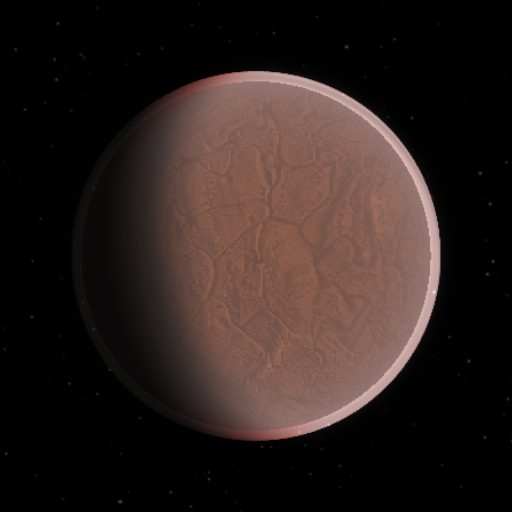
GJ 667 C b is the innermost planet of GJ 667 C, a red dwarf about 24 light-years away that belongs to a triple star system: it travels with a pair of stars, GJ 667 A and B. The planet orbits every 7.2 days and has a minimum mass of about 5.7 Earth masses, making it a super-Earth, heavier than Earth but lighter than Neptune.
It was the first planet found around the star. A 7.2-day signal had already been reported as a candidate, found by the radial velocity method, which detects the slight back-and-forth motion a planet's gravity gives its star. In 2012 a team led by Guillem Anglada-Escudé reanalysed four years of public HARPS data with a new technique, combined it with measurements from the Magellan and Keck telescopes, and found more signals, including GJ 667 C c on a 28-day orbit in the habitable zone. In 2013 the same team proposed as many as seven planets.
That larger system has been disputed, but GJ 667 C b is one of the two planets that survived. In 2014 a team led by Paul Robertson corrected the measurements for the star's magnetic activity, which can mimic planets. They confirmed b and c, attributed a 90-day signal to the star's rotation, and could not confirm the other proposed planets. At 7.2 days, GJ 667 C b orbits much closer to its star than the habitable zone, the range of distances where liquid water could last on a surface, so it is too hot for that. It has not been seen passing in front of its star, so its size is unknown.