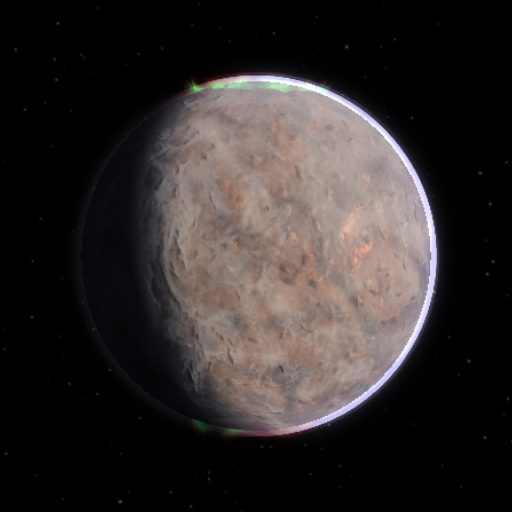
GJ 667 C e is a proposed planet whose existence is disputed. It was reported in 2013 as one of up to seven planets around GJ 667 C, a red dwarf about 24 light-years away that orbits a pair of other stars, GJ 667 A and B. In that model it circles GJ 667 C every 62 days and has a minimum mass of about 2.7 Earth masses.
It came from a 2013 study led by Guillem Anglada-Escudé. Combining measurements from three spectrographs, HARPS, PFS and HIRES, and using the radial velocity method, which detects the slight back-and-forth motion a planet's gravity gives its star, the team found the data were better described by six signals than by the two known planets alone. Their candidates e and f lay between the confirmed planet c and a 92-day signal, d. They argued that the system was dynamically packed, with no room left for more planets except one possible small planet, and they placed three of the planets, c, f and e, in the star's habitable zone, where liquid water could last on a surface. GJ 667 C e would be the coolest of the three: according to the NASA Exoplanet Archive, it would receive about a third of the light Earth gets from the Sun.
Its existence has not been confirmed. In 2014 a team led by Paul Robertson found that some of the star's signals track its magnetic activity. After correcting for that, they confirmed planets b and c, attributed the 92-day signal to the star's rotation, and could not confirm the remaining candidates, including e. It remains in the NASA Exoplanet Archive's list, but its status depends on future measurements. It has never been seen crossing in front of its star.