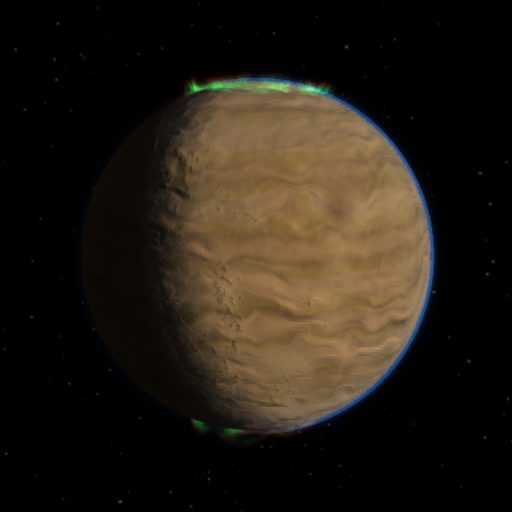
GJ 876 e completes a rare chain of three planets whose orbits are locked together. It is a planet about the mass of Uranus that orbits GJ 876, a red dwarf about 15 light-years away, every 125 days or so, the outermost of four known planets. Its period is close to twice that of GJ 876 b and four times that of GJ 876 c.
A team led by Eugenio Rivera reported it in 2010 from 12.6 years of measurements with the HIRES spectrograph at Keck Observatory, using the radial velocity method, which detects the slight back-and-forth motion planets' gravity gives their star. Its minimum mass is about 12.9 Earth masses, and about 14.6 if all the planets share one orbital plane. The team found it in a three-body resonance with c and b, a Laplace resonance: the orbital periods of c, b and e stand close to 1 to 2 to 4, and their positions stay linked through a single repeating relationship.
The same kind of resonance links three of Jupiter's moons, Io, Europa and Ganymede, but GJ 876's works differently. The moons never line up all on the same side of Jupiter, while the outer three planets of GJ 876 come close to doing so once every orbit of GJ 876 e. The team's simulations found the four-planet system stable for at least a billion years. Far from its dim star, GJ 876 e receives about a tenth of the light Earth gets from the Sun, with an estimated equilibrium temperature of about 150 kelvin. It has not been seen crossing its star, so its size is unknown.