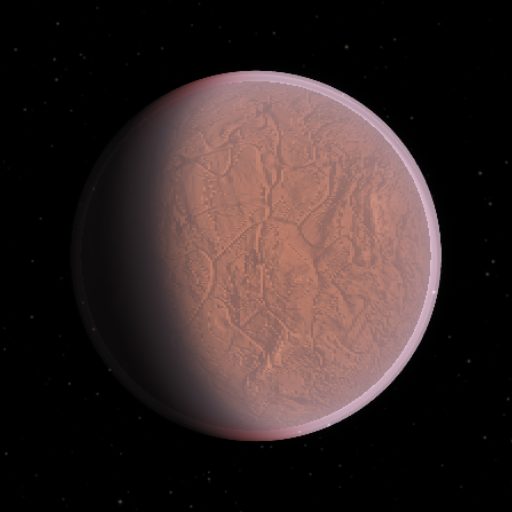
GJ 887 is the brightest red dwarf in our sky, about 10.7 light-years away, and GJ 887 b was one of the first two planets found around it. The RedDots team, led by Sandra Jeffers at the University of Göttingen, announced it and its neighbour GJ 887 c in the journal Science in 2020. They used HARPS, a spectrograph at the European Southern Observatory's La Silla Observatory in Chile, and the radial velocity method: a planet's gravity makes its star move slightly toward and away from us, and that motion shows up as a tiny shift in the star's light.
GJ 887 b is a super-Earth, a planet heavier than Earth but lighter than Neptune, with a minimum mass of nearly four Earth masses. It completes an orbit every 9.26 days. That is closer in than the star's habitable zone, the range of distances where liquid water could last on a surface, so it is expected to be too hot for that.
What makes the system stand out is the star. Many red dwarfs are covered in starspots and throw out frequent flares, which can strip the air from nearby planets and also confuse planet searches. The discovery paper found GJ 887 unusually quiet, with brightness changes below 500 parts per million. A steady, bright star makes its planets easier to study: the discovery paper notes that their light could be followed as they move around their orbits.
The 2020 paper also reported a third signal at 50 days that it could not yet confirm. In 2026 a team led by C. Hartogh added more than 100 new measurements and confirmed it as GJ 887 d, a super-Earth in the habitable zone, along with an Earth-mass planet, GJ 887 e, on a 4.4-day orbit. GJ 887 b's period was refined to 9.2619 days. None of the planets has been seen crossing in front of the star, so their sizes and true masses are not known; only minimum masses have been measured.