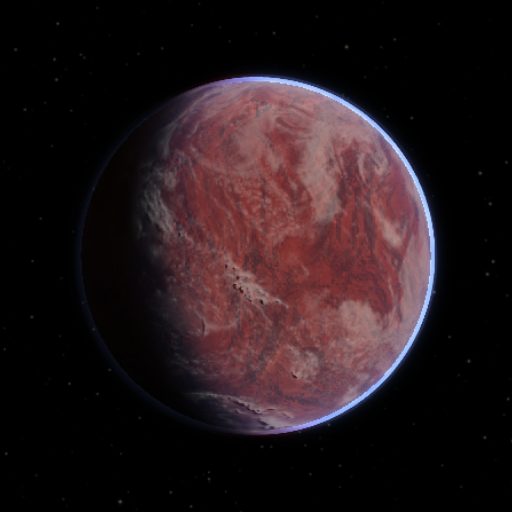
Gliese 12 b is the nearest known temperate, Earth-sized planet that crosses in front of its star, and it is often described as an exo-Venus. It orbits Gliese 12, a small, quiet red dwarf about 40 light-years away, every 12.76 days, and is about 0.93 to 1 times Earth's width.
It was announced in 2024 by two teams working independently. NASA's TESS satellite had seen only three transits, with gaps that left its orbital period uncertain. A team led by Shishir Dholakia pinned the period down with ESA's CHEOPS satellite and ground-based telescopes. A team led by M. Kuzuhara confirmed it with ground-based photometry, high-resolution images and measurements of the star's wobble, and X-ray observations showed the star to be unusually inactive for a red dwarf, which improves the chances that a planet there could keep an atmosphere. Both teams estimated an equilibrium temperature, set by starlight alone, of about 315 kelvin.
In 2025 a team led by Daisy Turner made the first precise measurement of its mass, about 0.95 times Earth's, using three spectrographs: HARPS-N, ESPRESSO and CARMENES. That gives a density consistent with Earth and Venus and a mostly rocky interior, and their simulations suggest it has not kept any of its original hydrogen envelope. It receives about 1.6 times the light Earth gets from the Sun, according to the NASA Exoplanet Archive, between Earth's and Venus's. That makes it one of the best targets for testing whether rocky planets around cool stars can hold on to atmospheres.