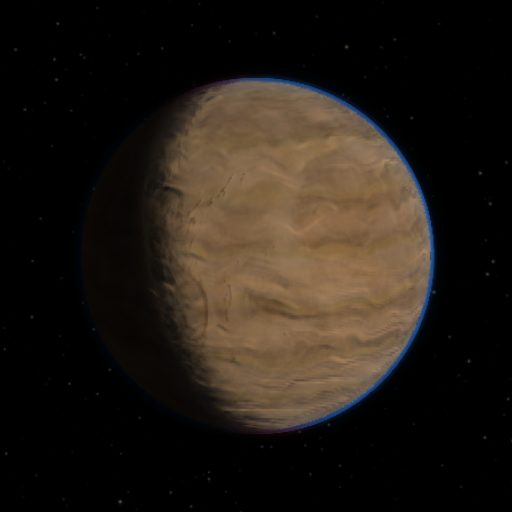
HD 100546 b may be a planet still in the process of forming. It is a source of infrared light embedded in the disk of gas and dust around HD 100546, a young star about 360 light-years away, about 10 million years old. Seen at a distance of roughly 50 times Earth's distance from the Sun, it appears to sit inside that disk rather than in front of or behind it.
A team led by Sascha Quanz reported it in 2013 from images taken with the Very Large Telescope in Chile at a wavelength of 3.8 microns, in the infrared. The source lined up with a dip in the disk's polarised light, hinting at a physical connection, and the team favoured a planet in formation over other explanations. In 2014 a team led by Thayne Currie detected it again independently with the Gemini South telescope, the first second detection of a directly imaged protoplanet candidate, and found it may be spatially resolved, perhaps 12 to 13 times Earth's distance from the Sun across.
Its nature is still debated. Its mass depends on how it is shining: standard models give about 15 Jupiter masses, but if it is newly formed or lit by a disk of material around it, it could be only 1 to 7 Jupiter masses. In 2015 Currie's team, using the Gemini Planet Imager, found its colours unusually red, possibly from material still falling onto it, and reported a possible second protoplanet closer to the star, though that feature could also be a bright patch of the disk. A short 2017 follow-up by the same team supported their original findings.