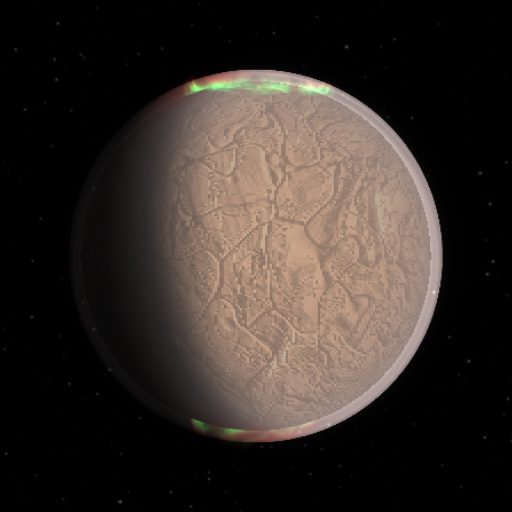
HD 110067 c is the second of six sub-Neptunes, planets between Earth and Neptune in size, that cross in front of HD 110067, a star a little smaller than the Sun about 100 light-years away. It orbits every 13.67 days, almost exactly one and a half times the period of its inner neighbour HD 110067 b, and is about 2.4 times Earth's width.
It was part of the 3 to 2 rhythm that a team led by Rafael Luque found among the three inner planets, using TESS and CHEOPS, which let them predict and then confirm the outer three in 2023. Luque's team could not measure HD 110067 c's mass from the star's wobble and set only an upper limit. In 2024 a team led by Caleb Lammers showed that the system is almost certainly in a chain of resonances, because similar systems that are not in resonance nearly always become unstable within 25 million years. That also let them set lower limits on the masses that had not yet been measured.
HD 110067 c's orbit has also been compared with the spin of its star. In 2024 a team led by J. Zak watched it cross the star with the ESPRESSO spectrograph, which can tell which side of the rotating star the planet blocks. They found its orbit well aligned with the star's equator, suggesting the planets drifted gently into their places without major disruptions. They also found that its transit arrived about 19 minutes off the predicted time, a sign of the planets tugging on each other. It receives about 40 times the light Earth gets from the Sun, far too much for liquid water.