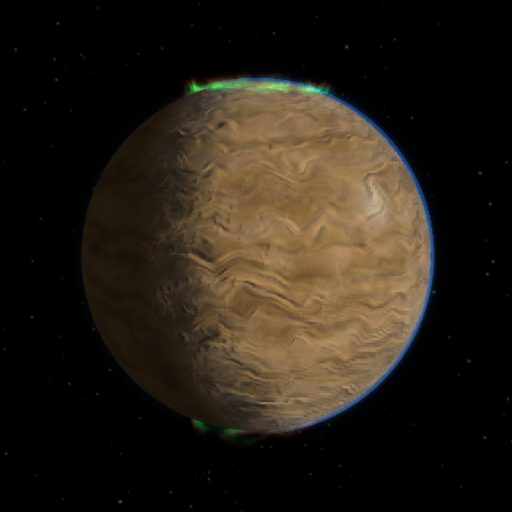
HD 219134 g is a planet reported by only one of the two teams that studied HD 219134, an orange dwarf star about 21 light-years away. It orbits every 94.2 days, and its minimum mass is about 11 Earth masses.
It was reported in 2015 by a team led by Steven Vogt, who measured the star's motion with 175 observations from the HIRES spectrograph at Keck Observatory and 101 from the Automated Planet Finder at Lick Observatory. That motion, the slight back-and-forth wobble caused by orbiting planets, contained six signals in their analysis. Several years of brightness measurements from Fairborn Observatory showed the star almost perfectly steady, which supports planets rather than starspots as the cause. A separate team led by Fatemeh Motalebi, with the HARPS-N spectrograph, reported four planets that year and did not include one at 94 days, so this planet has not yet had the same independent confirmation as its inner siblings.
HD 219134 g has never been seen passing in front of its star, so its size is unknown; the NASA Exoplanet Archive's radius is an estimate. At this distance it receives about twice the light Earth gets from the Sun, according to the archive. A 2026 study that reconstructed the star's history suggested the planets farther out probably kept part of their original envelopes of gas, unlike the stripped inner planets. The star's age, about nine billion years according to that study, makes this an old system compared with ours.