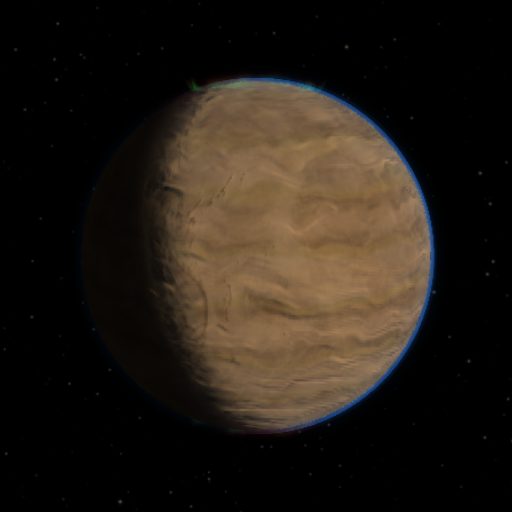
HD 219134 h is a giant planet on a wide orbit around HD 219134, an orange dwarf star about 21 light-years away. Its minimum mass is about 108 Earth masses, about a third of Jupiter's, and it takes about 2,250 days, a little over six years, to go around its star at roughly three times Earth's distance from the Sun.
A long orbit means a slow signal: its pull makes the star drift back and forth over years. A team led by Steven Vogt reported it in 2015 from measurements with the HIRES spectrograph at Keck Observatory and the Automated Planet Finder at Lick Observatory, and concluded that this outermost signal is unlikely to be caused by the star's activity cycle. The same year a team led by Fatemeh Motalebi, using HARPS-N, also found an outer giant, but with different properties: about 62 Earth masses on an orbit of about 1,190 days. The two teams' outer planets have not been reconciled, so the outer part of this system is less certain than the inner part.
HD 219134 h is far colder than its inner siblings. According to the NASA Exoplanet Archive, it receives about three percent of the light Earth gets from the Sun, with an estimated equilibrium temperature of about 120 kelvin. It has not been seen crossing its star, so its size is unknown and the archive's radius is an estimate. A 2026 study of the star put its age at about nine billion years.