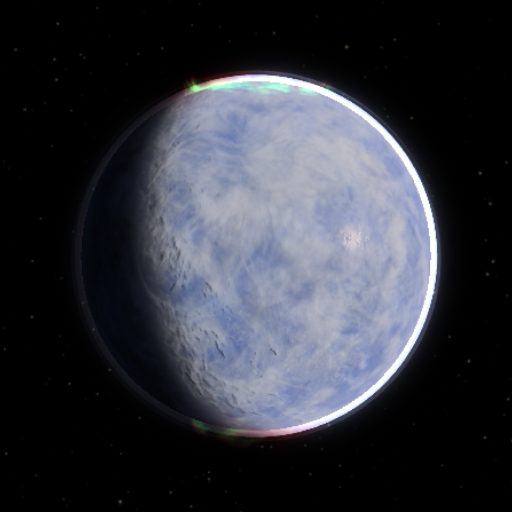
K2-155 d is the outermost of three super-Earths crossing in front of K2-155, an early red dwarf about 240 light-years away. It orbits every 40.7 days and is about 1.64 times Earth's width. NASA's K2 mission observed the star in its 13th campaign, and a team led by Teruyuki Hirano reported it in 2018 after confirming the planets with speckle imaging and spectra of the star.
The discovery team found that K2-155 d receives about 1.67 times the light Earth gets from the Sun, with a fairly large uncertainty, which puts it near the habitable zone, the range of distances where liquid water could last on a surface. To test whether it could be habitable, they ran three-dimensional climate simulations, assuming it is tidally locked with one side always facing the star and has an Earth-like makeup and atmosphere. The simulations showed it could keep a moderate surface temperature if it receives less than about 1.5 times Earth's light, so its habitability depends on a number that is not yet known precisely enough.
Its size also sits at an interesting place: between smaller planets that are usually rocky and larger ones that usually have thick gas envelopes. Its mass has not been measured, which would settle that. The team noted that K2-155 is one of the optically brightest red dwarfs known to host transiting planets, and that it is also poor in heavy elements compared with the Sun, which makes it a good target for measuring the planets' masses and atmospheres.