Create your free account

Enter your email and we'll send a 6-digit code — no password needed.
We only keep your email and the username you choose. We never share or sell your email, and we don't send marketing — we use it only to email you a sign-in code. Read our privacy policy.
Planet profiles

K2-18 b

Ice Giant · 124 light-years away · Last reviewed October 14, 2026

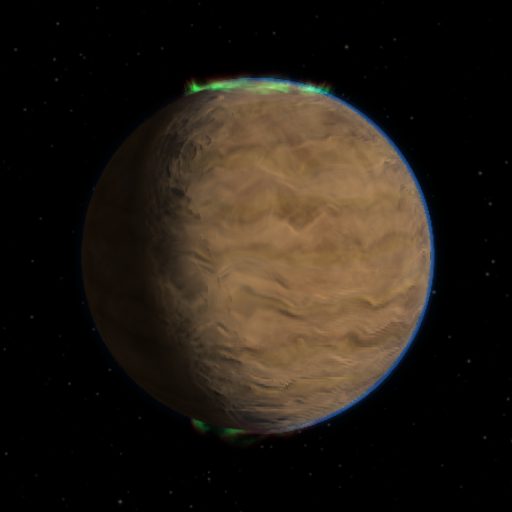
K2-18 b rendered in TerraForge from its measured mass, orbit and star
TerraForge's rendering of K2-18 b, generated by our physics engine from its measured mass, size, orbit and star. An illustration of what the science suggests, not a photograph.
TerraForge classification
Ice Giant
Host star
K2-18 (M2.5 V)
Distance
124 light-years
Orbit
32.9 days
Mass
8.92 × Earth
Radius
2.37 × Earth
Discovered
2015, transit

Figures from the NASA Exoplanet Archive. The classification is TerraForge’s, from its physics model.

Few distant worlds have drawn as much attention, or as much argument, as K2-18 b. It was found in 2015 when it passed in front of its star, a cool red dwarf about 124 light-years away. It orbits every 33 days inside the star's habitable zone, the range of distances where liquid water could exist. At 2.4 times Earth's width and almost 9 times its mass, it is a sub-Neptune: a planet between Earth and Neptune in size, a type our solar system lacks.

In 2023 a team led by Nikku Madhusudhan used the James Webb Space Telescope (JWST) to study starlight filtering through the planet's atmosphere. They reported methane and carbon dioxide, with little ammonia. They argued this fits a hycean world: a planet with a hydrogen-rich atmosphere over a global water ocean. They also saw a weak hint of dimethyl sulfide (DMS), a gas that on Earth comes from living things, mostly ocean plankton. In 2025 the same group reported a stronger signal, at about 3-sigma confidence, from JWST's mid-infrared instrument. They attributed it to DMS or a related gas, dimethyl disulfide, and said more data and lab work were needed.

Other teams disagree. A reanalysis led by Stephen Schmidt tried 60 ways of processing the 2023 data and found methane, but no reliable evidence for carbon dioxide or DMS. A team led by Rafael Luque combined all of JWST's data and found insufficient evidence for either sulfur gas, because other molecules fit just as well. They estimated about 25 more mid-infrared transits would be needed to settle it. A study led by Renyu Hu, using four new JWST observations, detected methane and carbon dioxide but only marginal hints of DMS, and showed that such gases can form without life in a hydrogen-rich atmosphere.

So methane is the one gas all these groups accept. Carbon dioxide is supported by some analyses and not others, and DMS is a contested claim, not a detection. The planet's interior is debated too. Hu's team favours a water-rich world, either a thick steamy envelope or a thin atmosphere over an ocean. Schmidt's team found the data fit an oxygen-poor mini-Neptune with no ocean at all.

TerraForge's model, working only from mass, orbit and star, classifies K2-18 b as an ice giant at about 324 K. That broadly matches readings that put deep water or high-pressure ice under a thick gas envelope, but the model cannot tell whether an ocean or life is there.

Sources

  1. Webb discovers methane and carbon dioxide in atmosphere of K2-18 b — ESA
  2. New Constraints on DMS and DMDS in the Atmosphere of K2-18 b from JWST MIRI — arXiv (The Astrophysical Journal Letters)
  3. A Comprehensive Reanalysis of K2-18 b's JWST NIRISS+NIRSpec Transmission Spectrum — arXiv (The Astronomical Journal)
  4. Insufficient evidence for DMS and DMDS in the atmosphere of K2-18 b. From a joint analysis of JWST NIRISS, NIRSpec, and MIRI observations — arXiv (Astronomy & Astrophysics 700, A284)
  5. A water-rich interior in the temperate sub-Neptune K2-18 b revealed by JWST — arXiv
A banded gas giant with four moons in different colors: a yellow sulfur moon, two rust-red rock moons and a blue water moon

New: Choose What Your Moons Are Made Of 🌙

Every moon used to be grey rock, white ice or blue ocean, decided for you. Now each one has a "Made of" choice in the builder's Moons tab — silicate rock, iron, water ice, carbon, sulfur, or nitrogen and methane ice — and the physics decides what that becomes. Put water ice too close to the star and it boils off to bare rock. Put sulfur where a neighbouring moon keeps it tidally flexed and it erupts in Io's yellows. Give a Titan-sized moon nitrogen ice far from the sun and it wraps itself in haze. Hang a water moon about the mass of Earth off a giant planet in the habitable zone and it can hold air and open seas — scored for life on the same scale as a planet, with a day as long as its orbit. A tint slider nudges the colour, but only as far as that material could really go.

Create your free account

Enter your email and we'll send a 6-digit code — no password needed.
We only keep your email and the username you choose. We never share or sell your email, and we don't send marketing — we use it only to email you a sign-in code. Read our privacy policy.

Send feedback

We're still building out the best experience we can — and we'd love your input. Tell us about features you enjoy, ideas you'd like to see, or pain points where something feels off, and we'll know where to look next.

Type
Idea
Bug
Pain point
Other