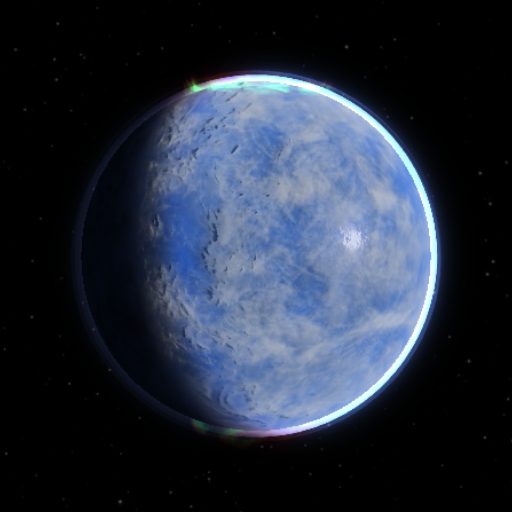
Kepler-1544 b is a planet about 1.8 times Earth's width in the habitable zone of an orange dwarf star about 1,100 light-years away. The habitable zone is the range of distances where a planet could keep liquid water on its surface. Kepler-1544 b crosses in front of its star every 168.8 days and receives about 80 percent of the light Earth gets from the Sun.
NASA's Kepler space telescope first listed it as a candidate, KOI-4036.01, from the small dip in starlight at each crossing. In 2016 a team led by Timothy Morton confirmed it as one of 1,284 Kepler planets validated in a single study, using a fully automated method that calculates how likely each signal is to be a false alarm, such as an eclipsing pair of background stars. In 2017 a team led by Guillermo Torres re-examined it with a different statistical method, BLENDER, along with new spectra and high-resolution images of the star, and validated it with about 99.9 percent confidence.
Torres's team was looking for the planets most likely to be both small and in the habitable zone, while allowing for the chance that a planet circles a faint star hidden behind the target, which would make it larger than it appears. Kepler-1544 b was one of seven candidates in their study with a better than 50 percent chance of being smaller than twice Earth's width and in the habitable zone. They estimated its equilibrium temperature, set by starlight alone, at about 270 kelvin. Its mass has never been measured, so whether it is rocky is not known.