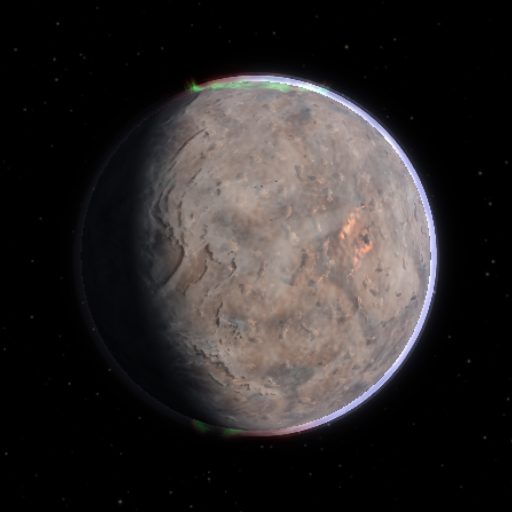
In April 2014 Kepler-186 f became the first Earth-size planet found in the habitable zone of another star, the range of distances where liquid water could pool on a surface. NASA's Kepler space telescope caught it passing in front of its star. A team led by Elisa Quintana of the SETI Institute at NASA's Ames Research Center announced it. Earlier habitable-zone planets were all at least 40 percent larger than Earth.
It is the outermost of five roughly Earth-size planets around a red dwarf about half the Sun's size, some 580 light-years away. It takes 130 days to orbit and receives about a third of the energy Earth gets from the Sun, placing it near the cold outer edge of the habitable zone. NASA called it an Earth cousin rather than an Earth twin.
Kepler measured its size, about 1.17 times Earth's width, but not its mass; the mass on this page is an estimate. Planets this size are likely rocky. Whether it has liquid water depends on its air, which has never been observed. Emeline Bolmont and colleagues calculated that an atmosphere with 0.5 to 5 bars of carbon dioxide could lift the surface above freezing; one bar is roughly the air pressure at Earth's sea level. Simulations by Yutong Shan and Gongjie Li found its axial tilt would stay steady if the tilt is modest and it spins about once a day, though the answer depends on its unknown spin and any moons.
TerraForge's model classifies Kepler-186 f as an ice world at about 208 K. That fits the bare numbers: its equilibrium temperature, the temperature it would have with no greenhouse warming, is about 177 K. But published climate models show a thick carbon dioxide atmosphere, which the model cannot know about, could make it temperate.