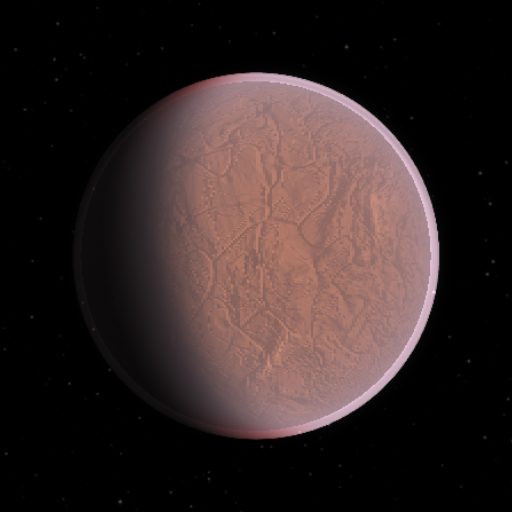
Kepler-296 b is the second planet out of five around Kepler-296, a pair of red dwarfs about 550 light-years away. Despite its letter, it is not the innermost: Kepler-296 c orbits closer in. Planet letters follow the order in which candidates were catalogued, not their distance from the star. Kepler-296 b crosses in front of its star every 10.9 days, and NASA's Kepler space telescope measured its radius at about 1.6 times Earth's.
Like its siblings, it was confirmed in 2014 in a study led by Jason Rowe that validated hundreds of Kepler planets at once, relying on the fact that stars showing several transit signals are rarely false alarms. A complication came later: Kepler-296 turned out to be two red dwarfs about 0.2 arcseconds apart, far too close for Kepler to separate, so for a while it was unclear which star the planets circle. A 2015 analysis led by Thomas Barclay compared the two possibilities and found that all five planets very likely orbit the brighter star, Kepler-296 A.
Its mass is not measured; the NASA Exoplanet Archive's figure of about 3.2 Earth masses is an estimate from its size. Without a measured mass, it is not known whether it is mostly rock or carries a substantial atmosphere. It receives about six and a half times the light Earth gets from the Sun, too much for liquid water. Its outer siblings Kepler-296 e and f receive about 1.4 and 0.6 times Earth's light, which places them within or close to the star's habitable zone.