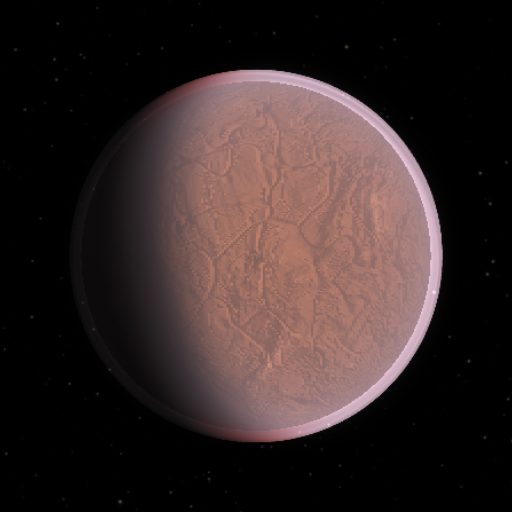
Kepler-296 c is the innermost of five planets around Kepler-296, a pair of red dwarfs about 550 light-years away. NASA's Kepler space telescope found it by catching the small dip in starlight each time it crossed in front of its star. It does so every 5.84 days, and the NASA Exoplanet Archive lists its radius as about twice Earth's.
It was confirmed in 2014 by a team led by Jason Rowe, as one of hundreds of Kepler planets validated in a single study. Their method rests on statistics: when a star shows several transit signals at once, it is very unlikely that they are all false alarms caused by something else in the field of view, so planets in such systems can be confirmed without measuring their masses. Later imaging showed that Kepler-296 is really two red dwarfs very close together on the sky, and in 2015 a team led by Thomas Barclay showed that all five planets almost certainly orbit the brighter one, Kepler-296 A.
Its mass has never been measured; the archive's figure of about 4.7 Earth masses is an estimate from its size. Planets about twice Earth's size can be dense and rocky or wrapped in thick gas, and without a measured mass the two cannot be told apart. Orbiting so close in, it receives about 15 times the light Earth gets from the Sun, far too much for liquid water. Its outer siblings Kepler-296 e and f are the ones that orbit within or close to the star's habitable zone.