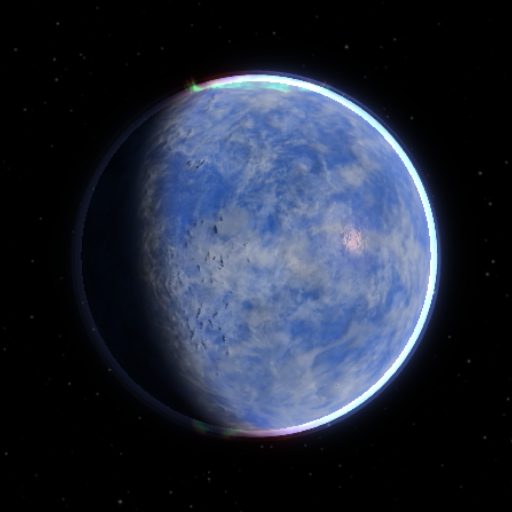
Kepler-296 e is one of two planets around Kepler-296 that orbit within or close to the habitable zone, the range of distances where liquid water could last on a surface. Kepler-296 is a pair of red dwarfs about 550 light-years away, and Kepler-296 e is the fourth of its five planets, crossing in front of its star every 34.1 days. NASA's Kepler space telescope found it by catching the small dip in starlight at each crossing.
Pinning down how much light it receives took some work. Kepler-296 is a pair of red dwarfs too close together for Kepler to separate, and the planet's size and the starlight reaching it both depend on which of the two it orbits. The five planets were confirmed in 2014 in a study led by Jason Rowe, but it was a 2015 analysis led by Thomas Barclay that showed they almost certainly orbit the brighter star, Kepler-296 A, and gave the outer planets' properties on that basis.
On that basis, Barclay's team found Kepler-296 e to be about 1.53 times Earth's width, receiving about 1.4 times the light Earth gets from the Sun. That is somewhat more than Earth receives, toward the inner, warmer side of the habitable zone. Its outer sibling Kepler-296 f receives about 0.6 times Earth's light. Kepler-296 e's mass has never been measured; the NASA Exoplanet Archive's figure of about 3 Earth masses is an estimate from its size. At about one and a half Earth radii, it could be rocky, but that is not established, and nothing is known about its atmosphere.