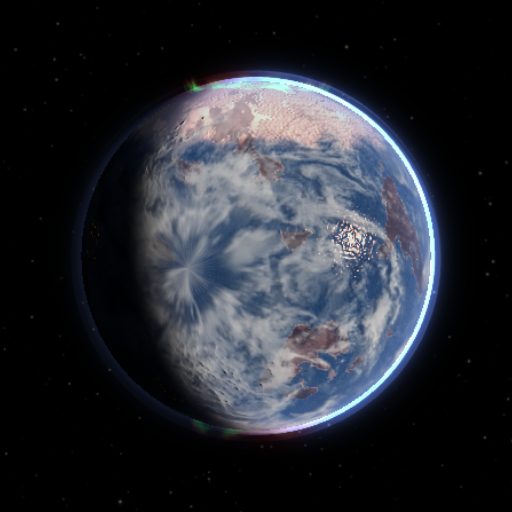
When astronomers announced eight new planets in their stars' habitable zones in January 2015, Kepler-442 b stood out. The habitable zone is the range of distances where a planet could, in principle, keep liquid water on its surface. Judged on size and the amount of starlight it receives together, the discovery team called Kepler-442 b and Kepler-438 b the most Earth-like planets found to that date. NASA's Kepler space telescope recorded its transits, the small dips in starlight as it passes in front of its star. A team led by Guillermo Torres of the Harvard-Smithsonian Center for Astrophysics confirmed it statistically, using a program called BLENDER to show a planet was by far the likeliest explanation for the signal.
Kepler-442 b is about 1.34 times Earth's width and orbits its star every 112 days. The star is smaller and cooler than the Sun, so even at about 0.41 times Earth's distance from the Sun, the planet receives only about two-thirds as much light as Earth. The team gave it a 97 percent chance of lying in the habitable zone and roughly a 60 percent chance of being rocky. It is about 1,190 light-years away.
A 2021 study added an unusual angle. Giovanni Covone of the University of Naples Federico II and colleagues asked whether planets in habitable zones get enough of the right kind of light to power oxygen-producing photosynthesis, the process plants use on Earth. Stars cooler than the Sun give off less light at the most useful wavelengths. Of the known potentially habitable planets, only Kepler-442 b came close to receiving enough to sustain a large biosphere like Earth's. That is a statement about starlight, not evidence of life.
Much is still unknown. No one has measured its mass, so its density, and whether it is really rocky, have not been tested. Nothing is known about an atmosphere. Even the starlight estimate is loose: the archive's range runs from about a quarter to nine-tenths of what Earth receives. As team member David Kipping put it in 2015, all the team could say was that these planets are promising candidates.
TerraForge's model, using a mass of 2.36 Earths that is estimated from the planet's size rather than measured, classifies it as an Earth-like world at about 264 K with a high habitability score. That fits its size and modest sunlight, but it rests on the same assumption as the science: that the planet is rocky, which is likely but unproven.