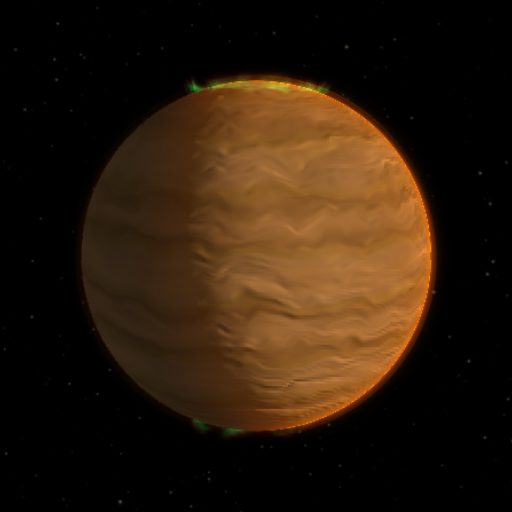
Kepler-51 b is a super-puff: a planet several times Earth's width with only a few times its mass, which makes it extraordinarily light for its size. It orbits Kepler-51, a young Sun-like star about 2,600 light-years away, every 45.2 days, and is one of at least four planets there.
Its mass came from timing, not weighing. The planets of Kepler-51 tug on one another, so their transits, the moments they cross the star, arrive a little early or late. In 2014 a team led by Kento Masuda modelled those shifts for the three transiting planets, which orbit close to a 1 to 2 to 3 ratio of periods, and found Kepler-51 b at about 2 Earth masses. Combined with their sizes, that gave all three planets densities among the lowest ever measured, under about 0.05 grams per cubic centimetre, far less than water.
The system kept surprising astronomers. When the James Webb Space Telescope observed a transit of the outermost planet, Kepler-51 d, ten years after Kepler, it arrived well off the time the three-planet model predicted. In 2024 Masuda's team showed that a fourth, outer planet, Kepler-51 e, explains the difference, though its mass and orbit are still loosely known. In their analysis the inner planets' masses stay low, so they remain super-puffs, though with larger uncertainties than before. Why planets this light are so large is still an open question.