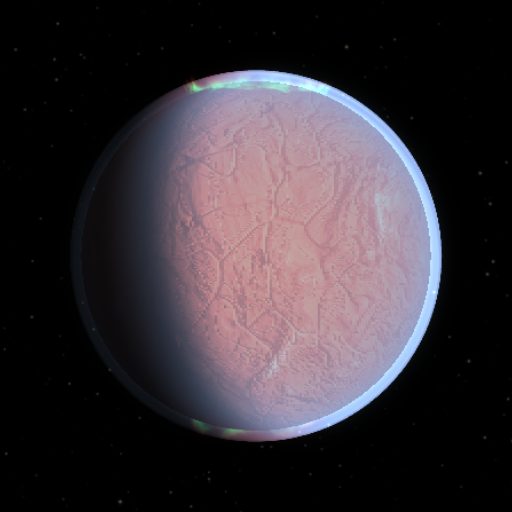
Kepler-90 i is the planet that made Kepler-90 the first known star to tie our solar system's count of eight planets, and it was found with artificial intelligence. Kepler-90 is a Sun-like star about 2,800 light-years away. Its eighth planet orbits every 14.4 days, third from the star, between Kepler-90 c and d. According to NASA, it is a rocky planet with an average surface temperature above 800 degrees Fahrenheit.
It was announced in December 2017 by Christopher Shallue of Google and Andrew Vanderburg, then a NASA Sagan fellow. They trained a neural network, a kind of machine-learning program, on about 15,000 signals from NASA's Kepler space telescope that people had already sorted into real planets and false alarms. They then used it to search for weak, previously missed signals around 670 stars already known to have several planets. The network flagged a faint signal around Kepler-90, which the team then validated statistically as a planet.
Its siblings were found the conventional way. Seven planets had already been reported around the star, the last four in 2013 by a team led by Juan Cabrera. The system resembles a compressed version of ours, with small planets close in and gas giants farther out, but all eight orbit within about the distance of Earth from the Sun. The NASA Exoplanet Archive lists Kepler-90 i at about 1.3 times Earth's radius. Its mass has not been measured; the archive's figure is an estimate from its size.