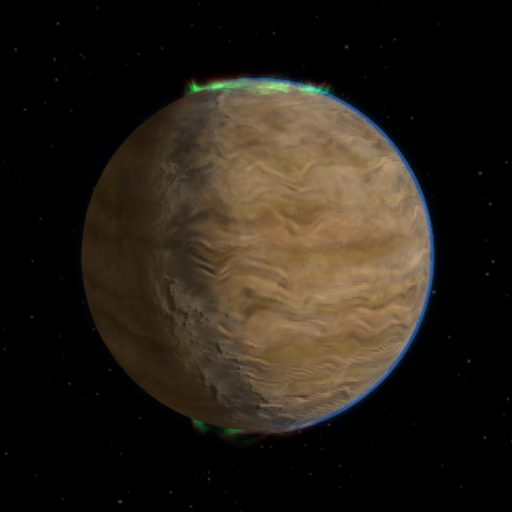
KOI-351 d, also known as Kepler-90 d, is the first of the system's larger planets, a mini-Neptune about 2.9 times Earth's width. It orbits Kepler-90, a Sun-like star about 2,800 light-years away with eight known planets, every 59.7 days. It was one of three planets listed around the star before 2013, in the Kepler mission's catalogue of planet candidates.
In 2013 a team led by Juan Cabrera validated it as a planet and refined its orbit, while adding four new planets to the system. They found that Kepler-90 d and its outer neighbours e and f form a chain of orbits close to a 2 to 3 to 4 ratio, so the three planets take turns pulling on one another. The Planet Hunters citizen-science project characterized the system independently the same year. Kepler-90 d is the fourth planet from the star, after b, c and the later-discovered i.
Its mass has not been measured; the NASA Exoplanet Archive's figure of about 8.6 Earth masses is an estimate from its size. Planets of this size usually have thick atmospheres of hydrogen and helium rather than bare rocky surfaces, which is why it is called a mini-Neptune rather than a super-Earth. It receives about 18 times the light Earth gets from the Sun, far too much for liquid water.